
Local SEO for Dentists: Proven Tactics to Boost Practice Visibility
Local search optimisation for dental practices focuses on the specific tactics that help clinics appear prominently for nearby patient queries, turning searches into booked appointments.
This article explains the mechanisms—Google Business Profile signals, local citations, on-page local SEO, and review generation—that drive higher visibility and conversion for dental clinics.
Many dental teams struggle to convert online visibility into steady local enquiries because they treat local SEO as a technical checklist rather than a patient-focused funnel; this guide offers a solution by combining practical, Australia-specific steps and measurement advice.
You will learn how to optimise your Google Business Profile, generate and manage patient reviews ethically, build and maintain consistent local citations, improve on-site local signals, and create location-specific landing pages that convert.
The following sections cover Google Business Profile features and optimisation, review strategies, citation building and auditing, website technical and local content improvements, conversion-focused local SEO tactics, and a measurement framework with KPIs and dashboards.
Throughout, the article uses local search optimisation for dentists, Google Business Profile dentists, and local citation building dental as guiding keywords to ensure practical SEO relevance.
How Can Google Business Profile Improve Your Dental Clinic’s Local Visibility?
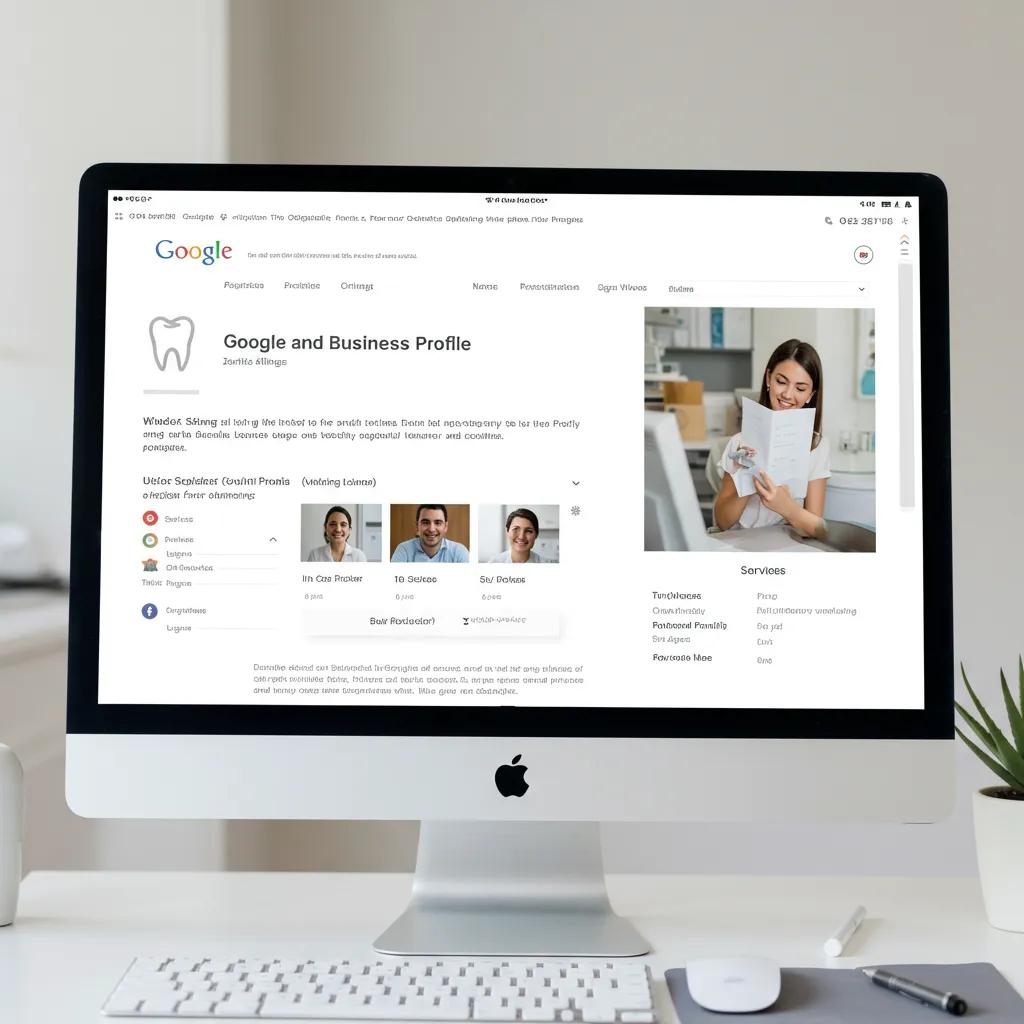
Google Business Profile (GBP) is the public listing that represents a dental clinic in Google Search and Maps; it improves local visibility by signalling relevance, proximity, and prominence to Google’s local algorithms, directly increasing patient discovery and actions.
A well-optimised GBP works by supplying structured, verified information and engagement signals—such as photos, services, and Q&A—that Google uses to rank clinics in the local pack and map results, which in turn raises appointment enquiries.
The immediate benefit is higher visibility for high-intent local searches and more direct patient interactions like calls, website clicks, and directions. The next paragraphs detail the GBP features dentists must prioritise and step-by-step optimisation actions to capture local demand.
The key GBP features for dentists centre on accurate categories, service listings, appointment links, and patient-facing content that builds trust and clarity. These features act as meronyms of the GBP listing, and each component contributes to local ranking signals and conversion, which we explore next.
What Are the Key Features of Google Business Profile for Dentists?
Google Business Profile features include the clinic name and categories, services entries, photos, attributes, appointment URLs, and the Q&A and reviews sections; each feature improves a specific patient-facing or ranking element.
Categories and service items directly influence relevance for query intent when a patient searches for treatments such as teeth whitening or emergency dentistry, while photos and videos increase click-through and trust.
Attributes like “wheelchair access” or payment methods add practical clarity that affects patient choice, and appointment links or booking buttons shorten the conversion path from search to booked visit.
Ensuring these fields are complete and consistent with on-site content closes the semantic loop between GBP and website signals and supports better local search outcomes.
How to Optimise Your Dental Clinic’s Google Business Profile Effectively?
Optimising a GBP listing begins with claiming and verifying the profile, selecting precise categories, and adding detailed service entries with patient-friendly descriptions that match on-site service pages.
Complete the profile by uploading professional photos of the clinic, team, and treatments, set accurate opening hours, and add appointment links where available to reduce friction for patients.
Monitor and respond to reviews, publish regular posts about offers and community involvement, and proactively manage Q&A to preempt common patient concerns.
Verification and ongoing activity increase prominence in GBP insights and help the listing surface for more local queries, which we explain further in the next section on engagement tools.
How Do Google Posts and Q&A Enhance Patient Engagement?
Google Posts and Q&A enhance patient engagement by providing timely content and answers that reduce uncertainty and encourage conversions from the listing itself; posts signal activity while Q&A handles common booking and treatment queries.
Regular posts about new services, limited-time offers, or patient education increase click-throughs to service pages and reinforce topical relevance for local search terms.
Proactively seeding the Q&A with common questions—such as sedation options or payment methods—and concise, privacy-compliant answers reduces friction and improves the patient experience.
Using short templates for posts and Q&A responses ensures consistent messaging and saves staff time while maintaining a high-quality listing.
| GBP Feature | Affects | Expected Benefit |
|---|---|---|
| Categories & Services | Search relevance for procedures | More accurate impressions and higher-qualified clicks |
| Photos & Videos | User engagement and trust | Increased CTR and appointment enquiries |
| Posts & Q&A | Listing activity and information clarity | Improved conversions and fewer pre-booking questions |
| Reviews & Responses | Social proof and prominence | Higher local ranking and patient trust |
Why Are Online Patient Reviews Crucial for Dentist Local SEO?

Patient reviews are evaluated by local search algorithms and human patients alike; they function as both a ranking signal and a persuasive trust indicator, increasing visibility and conversion for dental practices.
Reviews influence local ranking through volume, sentiment, and velocity—more recent positive reviews indicate prominence and relevance to Google’s local models—while their content and star rating strongly affect patient booking decisions.
The result is that consistent, authentic reviews raise a clinic’s chance of appearing in the local pack and improve click-to-call and appointment rates.
The following subsections cover ethical review-generation tactics, the ranking impact of reviews, and templates for responding to negative feedback to protect reputation.
Generating more positive reviews depends on timing, easy channels, and staff processes that respect healthcare privacy and ethical constraints.
The next subsection provides scripts and timing advice clinics can adopt.
Dental clinics can use the following tactics to encourage reviews while maintaining compliance and patient trust:
- Request at the Right Time: Ask after a successful, non-sensitive treatment session or follow-up when satisfaction is highest.
- Use Multiple Channels: Provide options by SMS or email with a simple guide to leave feedback, ensuring accessibility.
- Train Staff on Scripted Prompts: Short, respectful templates increase consistency and decrease staff hesitance.
Following these steps produces a steady flow of authentic reviews that support ranking and conversion, which connects to how review attributes specifically affect local search next.
How to Encourage More Positive Reviews from Dental Patients?
To encourage reviews ethically, request feedback at moments of satisfaction—such as after a routine cleaning or positive follow-up—and provide a clear, simple process that patients can complete on their preferred device.
Train reception staff to use short scripts that respect patient privacy and avoid coercion, for example by saying the clinic values feedback that helps improve services and patient experience.
Timing matters: sending a reminder within 24–72 hours of the appointment yields higher response rates while keeping the request concise increases completion.
Integrating the request into the post-visit workflow and monitoring response rates provides a reliable process that increases review volume sustainably.
What Impact Do Patient Reviews Have on Local Search Rankings?
Reviews impact local ranking through three measurable attributes: volume, sentiment, and recency, each sending signals about prominence and patient satisfaction to local algorithms.
Volume indicates popularity relative to competitors, positive sentiment raises click-through and conversion rates, and recency shows ongoing patient engagement with the practice; together these influence both algorithmic visibility and human selection.
Realistically, improving review signals translates into incremental ranking gains over weeks to months rather than overnight jumps, and clinics should pair reviews with citation and on-site improvements for the best outcomes.
Understanding these mechanisms helps practices set realistic expectations and prioritise consistent review strategies.
How to Respond to Negative Reviews to Protect Your Dental Practice Reputation?
Responding to negative reviews promptly and professionally mitigates reputational risk by demonstrating responsiveness, empathy, and a commitment to resolution without disclosing private health information.
Use a short response structure: acknowledge the patient’s concern, apologise for their experience, offer to continue the conversation offline, and provide a contact pathway for resolution while protecting confidentiality.
Maintain a neutral, helpful tone and avoid argument; escalating to an offline discussion allows you to address specifics and, when resolved, politely request an update to the review.
A strong response policy reduces the impact of negative reviews on prospective patients and signals active reputation management to search platforms.
| Review Action | Attribute | Impact |
|---|---|---|
| Increase review volume | Popularity signal | Higher local impressions |
| Improve review sentiment | Trust indicator | Better CTR and conversions |
| Respond to reviews quickly | Engagement signal | Maintains reputation and reduces churn |
The growing body of literature on online patient reviews highlights their importance in how patients select healthcare providers.
Online Patient Reviews for Dental Practices: An Analysis of Quality and Experience
Over the last few years, patient review websites have attracted increasing interest from health consumers, academic communities, and healthcare providers [1,2]. A significant volume of online patient reviews has been shared publicly via these platforms, becoming a common source of information for patients selecting a doctor. Consequently, a growing body of literature on online patient review studies has been developed, employing public health informatics methods to leverage data distribution and determinants for informing public health and policy, aligning with the Research Framework of Infodemiology and Infoveillance [3].
1. Background: Over the last two decades, patient review websites have emerged as a crucial online platform for doctor ratings and reviews. Recent studies have indicated the importance of such websites as a data source for patients choosing doctors, enabling healthcare providers to learn from and improve based on patient feedback, and fostering a culture of trust and transparency between patients and providers. However, compared to other medical specialties, studies focusing on online patient reviews for dentists in the United States remain scarce.
2. Objective: This study aimed to ascertain the extent to which online patient reviews can provide performance feedback reflecting dental care quality and patient experience.
3. Methods: Employing mixed informatics methods, including statistics, natural language processing, and domain expert evaluation, we analysed online patient reviews for 204,751 dentists extracted from HealthGrades with two specific objectives. Firstly, we examined the associations between patient ratings and various dentist characteristics. Secondly, we identified topics within patient reviews that could be mapped to the national assessment of dental patient experience, as measured by the Patient Experience Measures from the Consumer Assessment of Healthcare Providers and Systems (CAHPS) Dental Plan Survey.
Assessing patient experience and healthcare quality of dental care using patient online reviews in the United States: mixed methods study, Y Lin, 2020
What Is Local Citation Building and How Does It Boost Dental Practice Visibility?
Local citation building is the process of listing a dental clinic’s core contact and service information across authoritative directories and platforms; consistent citations reinforce NAP accuracy and support local search algorithms that prioritise reliable local business signals.
Citations work by creating external references to a clinic’s name, address, and phone data; search engines use the volume and consistency of those references to assess trust and authority for local queries.
The benefit is stronger local ranking stability, improved discoverability in aggregators and referral sources, and reduced likelihood of being outranked due to inconsistent information.
The following subsections prioritise citation sources for Australian dentists, outline auditing steps to enforce NAP consistency, and provide best-practice management routines.
High-value citation sources for dental clinics include national healthcare directories, local business directories, and specialised health listing platforms that patients commonly consult before booking; prioritising these sources yields the best visibility return.
The next subsection provides a tiered list of recommended citation sources.
Priority citation sources for Australian dentists should be chosen based on trust and local relevance:
- High-priority: National healthcare directories and major local business platforms that feed data to search engines.
- Medium-priority: State and local community directories, dental association listings, and health niche platforms.
- Low-priority: Smaller local aggregators or lifestyle sites that provide incremental coverage.
Selecting these platforms reduces duplication and improves authoritative coverage, which leads into practical steps for auditing and fixing NAP inconsistencies.
Which Local Citation Sources Are Most Effective for Dentists?
Effective citation sources for dentists include national health directories, local chamber or council listings, and specialist healthcare listing platforms; these sources carry greater trust and indexing frequency with search engines.
National directories and major business platforms supply broad exposure and are often used by mapping services to validate listings, while healthcare-specific platforms reach patients actively searching for clinical services.
Local council or community pages add geographic specificity and can support proximity signals for suburb-based queries.
Prioritising high-trust sources first reduces the risk of inconsistent data propagation and supports stronger local search presence.
How to Ensure Consistent NAP Information Across All Citations?
Ensuring NAP consistency starts with establishing a canonical source of truth for the clinic’s name, address, and contact details and using it for all listings; discrepancies should be resolved by auditing and updating each citation.
Perform a structured audit that lists existing citations, flags mismatches, and documents the preferred NAP format to reconcile differences; common mismatches include abbreviations, suite numbers, and phone formatting.
Use generic automation tools or manual updates where necessary and track changes with a spreadsheet to ensure follow-through.
Consistency reduces confusion for both patients and search engines and prevents signal dilution that harms local rankings.
What Are the Best Practices for Managing Local Citations for Dental Clinics?
Best practices for citation management include a documented cadence for checks, ownership assignment, and duplicate removal procedures that prevent data drift over time.
Set quarterly audits to verify listings, assign responsibility to an office manager or external partner, and use duplicate-finding methods to consolidate or remove redundant records.
Maintain a record of all submission credentials and dates to speed future updates and ensure brand consistency in naming and service descriptors.
Ongoing maintenance is essential to protect local visibility and prevent drops in discovery due to inconsistent or outdated information.
| Directory/List | Trust / Volume | Recommended Action |
|---|---|---|
| National health directory | High | Claim and verify first; maintain detailed service info |
| Local council/business listings | Medium | Add local signals and localised descriptions |
| Specialist dental platforms | Medium | Keep professional credentials and service pages up to date |
| Smaller local aggregators | Low | Use selectively to fill geographic gaps |
How Can Dentists Improve Their Website for Local SEO Success?
Improving a dental website for local SEO means optimising on-page elements, technical performance, and localised content so search engines and patients clearly understand the clinic’s services and service area; together these signals increase ranking and conversion.
On-page signals such as title tags, meta descriptions, service page structure, and local schema explicitly communicate relevance to search engines, while technical factors like mobile performance and site speed ensure accessibility and reduce bounce rates.
The direct benefit is higher organic rankings for local queries and improved conversion rates from search traffic into appointments.
The next subsections break down priority on-page elements, mobile optimisation tactics, and localised content templates clinicians can implement.
On-page elements must include localised titles, descriptive service pages, and schema markup tailored for dental services; concrete examples and templates follow to guide implementation.
Dental practices should prioritise the following on-page SEO elements:
- Title and meta templates: Include service + suburb to target local intent.
- Service page outlines: Clear H1s, procedure details, benefits, and CTAs.
- Local schema (LocalBusiness/Dentist): Structured data improves indexing and eligibility for rich snippets.
What On-Page SEO Elements Should Dental Practices Prioritise?
Dental practices should prioritise title tags and meta descriptions that include a primary service and locality, clear H1/H2 structure on service pages, and schema markup using LocalBusiness and Dentist types to provide structured context.
Craft service pages that answer patient questions—what the procedure entails, expected outcomes, who it’s for, and how to book—so both search engines and patients see direct value.
Include localised trust signals like suburb names, nearby landmarks, and geo-modified keywords naturally within content to avoid thin pages.
Well-structured service pages improve relevance and user experience, which feeds back into higher conversion rates.
How Does Mobile Optimisation Affect Dental Practice Visibility?
Mobile optimisation affects visibility due to mobile-first indexing and user behaviour: slow or poorly formatted pages lose ranking and have lower conversion rates from mobile searchers who make many local appointment queries on phones.
Ensure responsive design, fast image loading, and simplified booking flows to reduce friction for mobile users, as well as prioritise above-the-fold content and tap-friendly CTAs.
Implementing performance improvements such as compressed images and minimised scripts yields measurable improvements in page speed and bounce rates.
Since many local searches convert immediately, mobile UX directly impacts the number of patient calls and bookings a site generates.
Why Is Localised Content Important for Dental Clinics?
Localised content addresses the specific needs and queries of nearby patients by creating pages for suburbs, neighbourhoods, and common local concerns, increasing relevance for geo-modified searches and improving conversion through familiarity.
A practical local page template includes: a localised title and meta description, an intro that references the suburb and clinic, service sections tailored to local demand, patient testimonials from nearby residents, and a clear CTA for booking.
Avoid thin duplication by creating unique content elements per location—such as staff profiles, local case studies, or community involvement—to add distinct value.
Localised content builds topical authority and supports both direct search visibility and GBP relevance.
After implementing on-site recommendations, many practices benefit from external support; a lead-generation focused agency (Lead Generation & Information Hub) can help implement technical fixes, scale local content, and align schema and on-page signals with citations and GBP.
The agency role typically includes technical site audits, content templates for service and suburb pages, and ongoing optimisation to sustain local rankings.
Clinics interested in practical implementation should enquire through the agency’s website or via their Google Business Profile to request an implementation conversation and next steps.
Which Local SEO Strategies Drive More Patient Appointments for Dentists?
Local SEO strategies that convert visibility into booked appointments combine GBP optimisation, localised landing pages, citation quality, and conversion-focused website elements; these strategies work by shortening the path from discovery to booking and reinforcing trust at each touchpoint.
Localised landing pages and appointment-ready CTAs capture search intent, while accurate directory listings and positive social proof support visibility and patient confidence.
The resulting benefit is measurable increases in calls, online bookings, and new patient appointments.
The following subsections explain how to structure landing pages, prioritise directories, and use social media to support local acquisition.
Landing pages should be created with a clear structure—service headline, local relevance, benefits, social proof, and an obvious booking CTA—to maximise conversion and scale across multiple suburbs without producing thin content.
The next section outlines a reproducible template.
A scalable landing page template to attract nearby patients:
- Title & meta: Service + suburb for clarity.
- Hero section: Local value proposition, one-line benefit, and CTA.
- Service details: Short procedure overview, benefits, and FAQs.
- Social proof & CTA: Local testimonials and booking buttons.
How to Use Localised Landing Pages to Attract Nearby Patients?
Localised landing pages work by matching user intent with highly relevant content—title tags and headers that include the service and suburb, concise explanations of treatments, local trust signals, and a prominent booking CTA to convert traffic.
Include patient testimonials that reference the suburb, short FAQs addressing local concerns, and schema markup to enhance search visibility.
To scale pages without thin content, reuse structural templates while swapping unique local elements like staff profiles, nearby landmarks, and community involvement.
A consistent publishing cadence and internal linking from the main service pages helps search engines index location pages and improves their ranking prospects.
What Role Do Online Directories and Dental Listings Play in Patient Acquisition?
Online directories and dental listings drive referral traffic, validate credibility, and supply authoritative citation signals that feed into local ranking algorithms and patient discovery patterns.
High-priority directories have more referral volume and are crawled more frequently by search engines, whereas niche dental directories target patients actively comparing practices.
Optimised directory profiles with service descriptions, photos, and booking links can directly convert leads or funnel traffic to landing pages that close appointments.
Balancing directory maintenance with on-site conversion optimisation ensures listings deliver bookable leads rather than only passive exposure.
How Can Social Media Support Local SEO for Dental Practices?
Social media supports local SEO indirectly by amplifying localised content, promoting events or offers, and driving traffic to landing pages which in turn generates signals and social proof that influence patient decisions.
Share local case studies, appointment availability updates, and community posts that link back to service or location pages to increase visibility and referral traffic.
Encourage satisfied patients to share experiences and reviews on social profiles, and coordinate posts with GBP updates to maintain consistent messaging.
Social activity should be measured for referral volume and conversions so it remains focused on patient acquisition rather than vanity metrics.
A specialist resource can assist clinics with scaled local landing pages and citation management to accelerate appointment growth; clinics can request a free local visibility audit through the agency’s website or via their Google Business Profile to identify quick wins and a prioritised action plan.
How to Track and Measure the Success of Your Dentist Local SEO Efforts?
Tracking local SEO success requires a focused set of KPIs—local rankings, Google Business Profile actions, calls, website sessions from local landing pages, and appointment bookings—that tie activity to patient outcomes and revenue.
Measurement works by assigning meaning to signals: GBP actions indicate local intent engagement, calls and booking conversions represent direct patient acquisition, and ranking improvements increase qualified visibility.
Setting realistic targets and monthly monitoring provides feedback loops that guide optimisation priorities.
The following subsections list core metrics, explain how to use Google Analytics and Search Console for local insights, and highlight common measurement mistakes to avoid.
Core metrics should be benchmarked against practice size and market competition so clinics can interpret progress and prioritise tasks that drive bookings rather than vanity metrics.
The next subsection lays out suggested targets and tool usage.
The core local SEO metrics for dental clinics include impressions in local queries, GBP actions, calls, landing page sessions, and booked appointments; tracking these metrics links SEO work to real patient outcomes.
- Local pack impressions and positions: Measure visibility for priority keywords.
- GBP actions (calls, directions, website clicks): Direct engagement indicators.
- Calls and bookings: Primary conversion metrics for patient acquisition.
Which Metrics Best Reflect Local SEO Performance for Dental Clinics?
Primary metrics that reflect local SEO performance are GBP actions (calls, directions, website clicks), organic and local landing page sessions, local ranking positions for priority keywords, and the number of appointment bookings attributed to organic channels.
Secondary indicators include review volume and sentiment, citation coverage, and mobile page speed scores which influence conversion.
Suggested short-term targets might include measurable percentage increases in GBP actions and booking conversions month-over-month, adjusted for practice capacity.
Prioritise metrics that map directly to appointments and revenue to ensure SEO work drives tangible business outcomes.
How to Use Google Analytics and Search Console for Local SEO Insights?
Use Google Analytics to track landing page sessions, goal completions for booking forms and call-tracking events, and segment traffic by geo-location to isolate local users; Google Search Console provides query-level data and impressions for pages and can reveal which localised pages are gaining traction.
Set up goals and event tracking for appointment form submissions and phone clicks, and use UTM tagging where appropriate for campaigns promoting local pages.
Regularly review the Search Console Performance report filtered by page or query to identify ranking opportunities and compare CTRs for meta testing.
Proper configuration ties search signals to conversions and supports data-driven local optimisation.
What Are Common Local SEO Mistakes Dentists Should Avoid?
Common local SEO mistakes include inconsistent NAP across citations, thin local pages that duplicate content, ignoring GBP details, and failing to measure calls and bookings properly; each of these errors reduces search visibility and conversion opportunities.
Remediate these issues by establishing a single NAP reference, using unique local content on each page, completing and maintaining GBP fields, and implementing call- and booking-tracking to measure outcomes.
Run quarterly audits to detect regression and assign ownership for corrections so issues do not reoccur.
A disciplined measurement and maintenance approach prevents common pitfalls and preserves long-term local search traction.
| Metric | Why it Matters | Target/Benchmark |
|---|---|---|
| GBP Actions (calls/directions) | Direct patient intent and engagement | Increase 10–25% QoQ depending on baseline |
| Organic landing page sessions | Measures localised content performance | Positive trend month-over-month |
| Bookings attributed to organic | Revenue-linked conversion metric | Track absolute increases aligned with capacity |
| Review volume & sentiment | Trust and prominence signal | Maintain steady monthly inflow and 4+ star average |
A final practical note: clinics seeking hands-on support with measurement dashboards, local landing page builds, and citation management can source lead generation and local SEO assistance from a specialist described as a Lead Generation & Information Hub.
For a consultation or to request a local visibility audit, contact can be initiated via the provider’s website or their Google Business Profile.
This article has covered Google Business Profile optimisation, review-generation and management, citation building and NAP consistency, website improvements for local performance, conversion-focused tactics including localised landing pages, and a measurement framework with practical KPIs to tie activity to bookings.
Implementing these strategies in a coordinated program will strengthen local visibility and increase patient appointments, and clinics can pursue further support through specialist lead-generation and local SEO resources offered by agencies positioned as Lead Generation & Information Hubs.
For next steps and a tailored local visibility review, clinics are advised to enquire through the agency website or via their Google Business Profile to schedule an audit and implementation plan.