
Targeted Google Ads for New South Wales Dental Practices: Effective Patient Acquisition and PPC Strategies
Google Ads can be a high-impact channel for New South Wales dental practices that need faster patient acquisition and measurable return on marketing spend. This guide explains how intent-driven search, local targeting and tailored ad formats convert searchers into booked appointments, showing practical steps from campaign setup to regional optimisation and compliance. You’ll learn why search campaigns and call-only ads drive immediate leads, how to structure campaigns and landing pages for higher conversion rates, and methods to measure cost per acquisition and ROAS accurately. The article covers campaign setup best practices for Sydney dentists, budgeting scenarios and tracking frameworks, regional targeting tactics for suburbs and LGAs, compliance considerations under Australian healthcare advertising rules, and anonymised 2024 case study outcomes. Target keywords such as Google Ads NSW dentists, NSW dental PPC, and dental PPC campaign optimisation are woven through tactical recommendations so practices and marketers can implement proven PPC strategies that increase booked appointments while staying compliant.
How do Google Ads improve patient acquisition for NSW dental practices?
Google Ads improve patient acquisition by reaching people with active search intent for dental care and directing them to conversion-focused pages or call actions. Search campaigns capture users searching for treatments, appointment booking, or emergency dental care, while ad extensions and call-only formats increase the chance of immediate contact. The mechanism is straightforward: targeted keyword bidding + localised ad creative → qualified clicks or calls → optimised landing pages → booked appointments, and this creates measurable pipelines that can be tracked to cost per acquisition. For NSW dentists, combining high-intent keywords with location signals reduces wasted spend and increases the likelihood that an an ad click becomes a new patient.
Targeted campaigns depend on structured campaign architecture, relevant ad copy, and conversion tracking that links clicks to offline bookings. The next subsection lists specific benefits dental clinics in New South Wales typically observe when using targeted PPC campaigns.
Benefits of targeted PPC campaigns for dental clinics in New South Wales
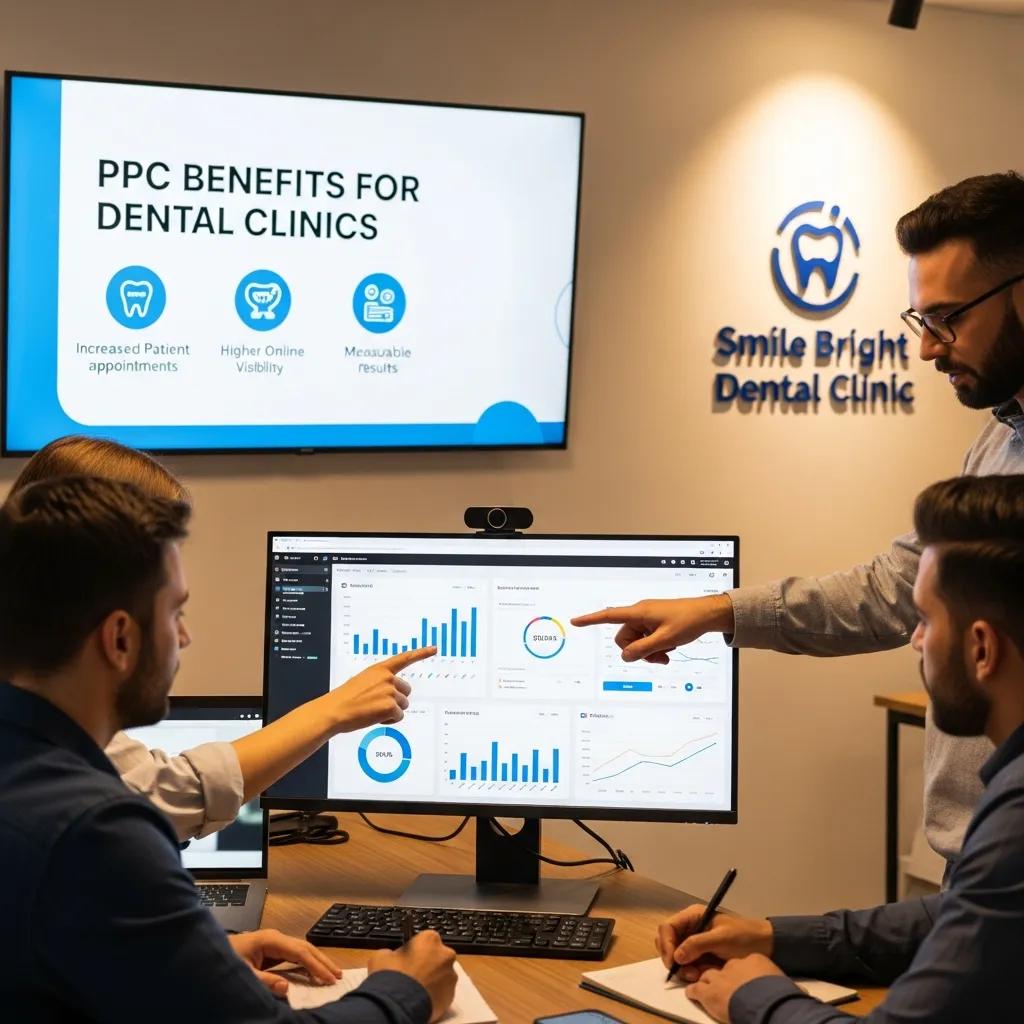
Targeted PPC delivers immediate visibility and measurable lead flow, making it easier for clinics to fill appointment slots and scale patient acquisition. Below is a concise list of typical benefits and examples of expected outcomes when campaigns are set up correctly.
- Immediate visibility for high-intent searches: Ads appear at the top of results for queries like “emergency dentist Sydney” and capture booking opportunities.
- Control over spend and targeting: Daily budgets and bid adjustments let clinics prioritise profitable suburbs and appointment types.
- Measurable lead generation and tracking: Conversion tracking links clicks to calls and bookings so practices can calculate cost per acquisition.
These benefits translate to actionable improvements such as higher call volumes and predictable appointment rates. Understanding these outcomes leads into how agencies and specialists apply localised tactics to maximise results for NSW dental markets.
How Milkcan Marketing tailors Google Ads to local dental markets
Milkcan Marketing is a specialised digital marketing agency focused on healthcare providers, with a strong emphasis on targeted Google Ads campaigns for dental practices in New South Wales. The agency’s approach segments local audiences by suburb and service type, applies regionally optimised keyword lists, crafts compliance-aware ad copy and pairs ads with structured landing pages and conversion tracking. This workflow—audience segmentation, keyword selection, ad copy localisation, landing page alignment and tracking—ensures campaigns generate measurable patient leads while respecting healthcare advertising standards. Clinics considering external management can expect an emphasis on local market targeting and a results-driven approach tailored to small healthcare practices. For more information on their services, visit Milkcan Marketing’s dental marketing services.
What are the best PPC campaign setup practices for dentists in Sydney?
Effective Sydney-focused dental PPC begins with clear goals, tightly themed campaign structures, and tracking that captures phone calls and bookings as conversions. Start by defining primary KPIs (calls, online bookings), then build search campaigns grouped by treatment or intent (e.g., cosmetic, emergency, general dentistry). Campaigns should prioritise high-intent search keywords with location modifiers and use ad extensions—call, location, sitelinks—to increase real estate and click-to-call rates. Landing pages must mirror ad intent with clear CTAs and simple booking flows to maximise conversion rate, and GCLID-based conversion tracking plus call-tracking completes the attribution picture.
Below is an EAV comparison of common campaign types, their best use-cases and example settings to guide setup choices for Sydney clinics.
Different campaign types suit different objectives and KPIs for a dental practice.
| Campaign type | Best use-case / Targeting | Example settings & KPIs |
|---|---|---|
| Search campaigns | Capture high-intent appointment and treatment queries | Broad match modified + phrase match; CPC target based on local CPC; KPI: CPL (calls/bookings) |
| Call-only campaigns | Maximise immediate phone leads during clinic hours | Ad schedule set to opening hours; high CPC bid; KPI: Calls per day |
| Remarketing | Re-engage site visitors who didn’t book | Audience: 30-day site visitors; CPA target for return visits; KPI: Return conversion rate |
| Local Service / Local campaigns | Visibility in local map and proximity searches | Radius targeting, location extensions; KPI: Footfall / appointment share |
This structured approach helps decide where to invest first and how to measure early wins. The next subsection gives a step-by-step launch checklist to follow when building the campaign.
Step-by-step guide to creating effective dental PPC campaigns
Begin with clear objectives, then build, test, and optimise campaigns iteratively to increase booked appointments and reduce cost per acquisition. The numbered steps below form an actionable launch plan for Sydney dental practices.
- Define goals and KPIs: Choose primary conversions (phone calls, online bookings) and set target CPL or ROAS.
- Research keywords and intent: Prioritise high-intent treatment + location keywords, then create negative keyword lists.
- Structure campaigns and ad groups: Use tightly themed ad groups (e.g., “teeth whitening Sydney”) with 8–12 keywords each.
- Create conversion-focused landing pages: Match ad messaging to landing page content and include clear booking or call actions.
- Implement tracking: Enable GCLID, set up conversions in GA4/Google Ads, and add call-tracking for offline calls.
- Test and iterate: Run A/B tests on headlines, landing pages, and bid strategies; pause poor performers and scale winners.
Following this sequence ensures a replicable, data-driven setup that improves with weekly optimisation. The next subsection explains keyword research and selection to support these steps.
Keyword research and selection for dental practice advertising
Keyword selection should balance high transaction intent with local modifiers and defensive negatives to avoid irrelevant spend. Focus on three keyword tiers: high-intent treatment keywords with suburb modifiers, mid-intent informational queries for remarketing, and branded terms to protect local presence. Use negative keywords to filter job searches, wholesale inquiries, or non-local traffic. Sample keyword categories include urgent care (e.g., “after hours dentist Sydney”), cosmetic treatments (e.g., “veneers cost NSW”), and booking intents (e.g., “book dental appointment Sutherland Shire”).
A practical rule is to prioritise keywords where estimated CPC aligns with the lifetime value of a patient, then optimise match types and bids to control acquisition cost. This selection informs ad copy and landing page messaging to increase quality score and reduce CPC over time.
How can dental practices optimise Google Ads budgets and measure ROI?
Optimising budgets and measuring ROI requires scenario-based planning and clear attribution of conversions to campaigns. Begin by allocating more budget to high-intent search and call-only campaigns, reserve a portion for remarketing tests, and set aside a small percentage for experimentation. Measurement combines direct conversion tracking (online bookings), call tracking (phone leads), and attribution windows in GA4 to estimate true cost per patient acquisition. Regular review cycles—weekly for bids and ad tests, monthly for strategy—help reallocate budgets to the best-performing campaigns and suburbs.
Below is a table presenting budget scenarios for different practice sizes, with expected leads, estimated CPC and target ROAS to help clinics plan monthly spend.
Practical monthly budget scenarios for dental PPC planning.
| Budget scenario | Monthly spend | Expected leads (est.) | Estimated CPC / target ROAS |
|---|---|---|---|
| Small practice | $1,200 | 18–30 leads | CPC $4–8; target ROAS depends on treatment value |
| Medium practice | $3,000 | 45–75 leads | CPC $3–7; aim for break-even CPA then scale |
| Growing practice | $6,000 | 90–180 leads | CPC $2.5–6; target ROAS higher with scaled ops |
These scenarios provide starting expectations; actual results depend on local competition and service mix. The next subsection outlines hands-on methods to improve return on ad spend and track outcomes.
Budgeting strategies for cost-effective dental PPC campaigns
Allocating budgets efficiently involves prioritising high-intent inventory and scaling on positive ROI signals while protecting margins during testing. Start conservatively with daily budgets aligned to expected lead volumes and increase spend on campaigns that hit CPA targets. Allocate roughly 60–70% to search and call-only campaigns, 20% to remarketing and testing, and 10–20% to prospecting or display. Reserve testing funds to trial new keywords, ad variations and landing pages to find incremental gains.
- Scale winners: Move budget from low-performing ad groups to those with proven CPA.
- Automate where sensible: Use target CPA or ROAS bidding after you have conversion volume to feed Smart Bidding.
- Protect margins: Monitor high-cost keywords and add negatives to prevent wasted clicks.
These budgeting habits improve efficiency and maintain predictable acquisition costs. The following subsection explains tracking frameworks and optimisation cadence to measure ROI reliably.
Methods to track and improve return on ad spend for NSW dentists
Accurate ROI measurement combines online conversion tracking, call-tracking and appropriate attribution settings. Implement GCLID-based tracking for form fills and booking widgets, enable GA4 event capture, and use a dedicated call-tracking solution to attribute phone leads to campaigns. Monitor KPIs such as conversion rate, cost per lead, cost per acquisition and patient lifetime value to calculate ROAS at campaign and account level. Iteratively improve ROAS by pausing low-converting keywords, raising bids on top performers, testing ad copy and refining landing pages.
A regular optimisation rhythm—weekly checks for search terms and bids, monthly strategic reviews—keeps campaigns aligned with business outcomes and reduces wasted spend. For practices seeking managed support, a short engagement with a specialist can accelerate learning and improve ROAS through structured testing and local market expertise. For professional assistance, explore Milkcan Marketing’s dental marketing services.
For clinics interested in managed services, Milkcan Marketing provides tailored Google Ads campaign creation and management focused on healthcare regulations, local NSW targeting, and results-driven optimisation that aligns spend to appointment outcomes.
What regional targeting strategies enhance Google Ads performance for NSW dentists?
Regional targeting refines spend by prioritising high-value suburbs, LGAs and commuter corridors rather than using broad state-level bids. Use suburb-level and radius targeting to capture the most relevant searchers, applying bid modifiers for high-conversion areas and excluding distant regions with low conversion rates. Geographic data such as patient postcodes and search volumes guides prioritisation, and mapping patient origins to campaign bids helps allocate budget where return is strongest. Using LocalBusiness and MedicalBusiness structured data on service pages also supports local relevance and can complement paid search efforts. For improving local search rankings, consider local SEO for dentists.
The table below helps clinics prioritise suburbs by search volume and suggested radius/bid adjustments based on local competition and conversion patterns.
Prioritise local areas based on search volume and conversion data.
| Region / Suburb | Search volume & competition | Suggested radius & bid adjustment |
|---|---|---|
| Inner-city suburbs | High volume, high competition | 5–10 km radius; +10–25% bid modifier |
| Middle-ring suburbs | Moderate volume, moderate competition | 10–15 km radius; neutral bids |
| Outer suburbs / rural | Lower volume, low competition | 15–25 km radius; -10–25% bid modifier |
Mapping patient origins and iteratively adjusting bids by suburb increases lead efficiency and reduces waste. The next subsection outlines practical local targeting tactics to implement these insights.
Local targeting best practices for Sydney and broader New South Wales
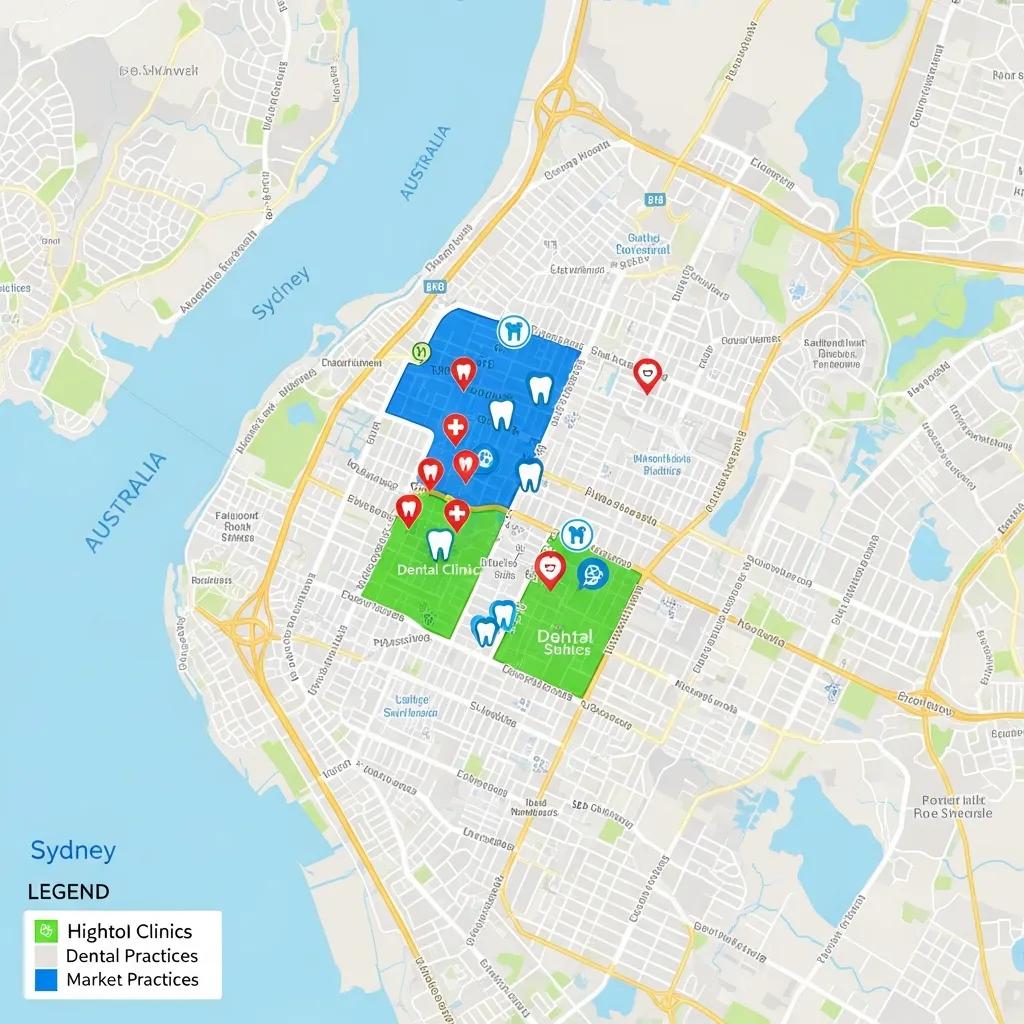
Set up multiple location targets with separate campaigns or ad groups to tailor bids and creative by area, allowing you to control spend where conversions are strongest. Use radius targeting around clinic locations for convenience-based services and create bespoke ad copy and sitelinks that reference nearby suburbs to improve relevance and click-through rates. Monitor search term reports by location to discover hidden demand and add negative locations to prevent irrelevant traffic. Test different radii (for example, 5 km vs 15 km) and compare conversion metrics to refine the optimal catchment area.
Consistent measurement of conversion rates by location helps you prioritise suburbs and reallocate budget where patient acquisition is most cost-effective. Using geographic heatmaps of patient postcodes further informs which areas deserve higher bids or dedicated campaigns.
Using geographic data and maps to refine dental PPC campaigns
Collect patient postcode data from practice management systems or intake forms and visualise it on heatmaps to identify high-conversion areas and patient origin clusters. Cross-reference these maps with search volume and competitive CPC data to set bid modifiers and create targeted campaigns for top suburbs. Tools that overlay postcode-level conversion rates make it straightforward to prioritise high-value zones and reduce bids where conversion is poor.
A simple workflow—gather patient origin data, map concentrations, test adjusted bids and measure conversion uplift—yields clear decisions on where to invest incremental budget. Regularly refresh mapping data to account for seasonal shifts and new catchment patterns.
How do healthcare advertising regulations impact Google Ads for dental practices?
Advertising regulations shape what claims dental PPC ads and landing pages can make, requiring careful language and evidence for clinical statements. In Australia, healthcare advertising rules and advertising standards expect truthful, non-misleading claims, appropriate disclosure of qualifications and cautious use of before/after imagery or testimonials. Ads and landing pages should be reviewed to avoid unsubstantiated promises about outcomes and to ensure any pricing claims are transparent and not deceptive. Practitioners should view compliance as integral to ad copy and landing page design to reduce the risk of complaints or enforcement action.
Understanding regulatory constraints early prevents costly ad rejections and reputational risk while ensuring campaigns remain effective and credible. The compliance checklist below summarises actionable items for PPC ads and landing pages.
Compliance requirements for dental PPC campaigns in Australia
Ads must avoid unverifiable clinical claims, be clear about who is providing the service, and ensure any pricing or promotional language is accurate and not misleading. Avoid superlative or absolute claims without clinical evidence, and ensure landing pages substantiate any advertised benefits with clear information on the practitioner’s qualifications and the procedure. When using images or patient stories, secure explicit consent and ensure content aligns with local advertising guidance.
- No misleading clinical promises: Phrase outcomes carefully and avoid absolute guarantees.
- Disclose qualifications: State provider credentials where relevant.
- Support claims on landing pages: Provide detail that substantiates ad language.
Adhering to these points minimizes compliance risk and supports long-term campaign sustainability. The next subsection answers common PAA-style questions about dental advertising rules.
Common FAQs on advertising regulations for NSW dental providers
Below are concise answers to common regulatory questions that dental practices encounter when advertising in New South Wales.
- Can I advertise before/after photos?: Use before/after images only with informed consent and ensure images are not misleading about typical results.
- Are price promotions allowed?: Price promotions can be advertised but must be accurate, include terms and not be deceptive about ongoing costs. For details on pricing and marketing packages, see Milkcan Marketing’s pricing packages.
- Can I use patient testimonials?: Testimonials require consent, must be genuine and not imply guaranteed outcomes.
These short, direct answers help practices make compliant decisions; when in doubt, seek formal regulatory advice to interpret specific scenarios.
What recent case studies demonstrate successful Google Ads for NSW dental clinics?
Recent 2024 campaigns demonstrate that focused, intent-driven Google Ads setups significantly increase new patient leads while lowering cost per acquisition through testing and local optimisation. Typical anonymised results show a rise in monthly leads of 40–120% after restructuring campaigns into tight ad groups, implementing call-only ads and aligning landing pages with ad intent. High-intent search campaigns and radius-targeted bids often perform best for appointment bookings, while remarketing recovers warm visitors to convert at a lower CPA. Key tactics included prioritising suburb-level bids, using ad extensions to drive calls, and A/B testing landing pages for higher conversion rates.
A concise anonymised result example: after optimisation, a mid-sized clinic saw leads increase by 65% with a 22% reduction in cost per lead over three months, driven by refined keywords, call-only ads and suburb bid adjustments. These outcomes show replicable levers for similar practices.
2024 patient acquisition results from targeted dental PPC campaigns
Anonymised campaign summaries from 2024 reveal consistent patterns: search and call-only campaigns deliver the majority of immediate leads, while remarketing improves conversion efficiency. Bullet points below highlight typical, anonymised KPI improvements observed after optimisation.
- Leads increased 40–80% within 8–12 weeks of campaign restructure.
- Cost per lead decreased 15–30% after implementing negative keywords and landing page tests.
- Call-only ads accounted for 30–60% of phone leads in clinics optimised for call conversions.
These anonymised results emphasise practical levers—keyword trimming, local bids and conversion-focused landing pages—that clinicians can replicate. The closing subsection translates management insights into next steps for clinics considering external support.
Insights from Milkcan Marketing’s dental Google Ads management
Milkcan Marketing’s experience managing NSW dental Google Ads highlights three consistent optimisation levers: precise local keyword segmentation, ad copy aligned to treatment intent and reliable call/booking tracking to close the measurement loop. Their approach emphasises healthcare compliance in ad messaging, suburb-level bid adjustments, and a test-and-scale methodology that focuses on measurable patient acquisition outcomes. Clinics interested in a managed approach are encouraged to inquire about tailored campaigns that align spend with appointment outcomes and regulatory best practice. For more on their specialised offerings, visit Milkcan Marketing’s dental marketing services.
For practices seeking assistance with setup, optimisation or compliance-aware ad management, engaging a specialist can accelerate improvements in lead volume and cost control.
For clinics that prefer to discuss managed options, Milkcan Marketing offers specialist Google Ads management for NSW dental practices focused on local targeting, compliance-aware messaging and measurable patient acquisition. Please inquire directly with the agency for tailored proposals and case-specific estimates.