
Attributing Value to Marketing Channels

Healthcare Marketing Attribution: Channel Value for Australian Clinics
Marketing attribution tracks which marketing interactions lead to patient enquiries and bookings, so clinics can see which channels actually bring new patients and revenue. This guide explains attribution for Australian small practices and shows how attribution models, PAC calculations, KPI monitoring and practical setup work together to improve patient acquisition cost and marketing ROI. Many small dental, chiropractic and physiotherapy clinics find it hard to know what to scale because patient journeys are multi-touch, include offline calls and bookings, and span Google, social and local discovery. Here we give clear definitions, model comparisons, worked PAC and ROI examples, KPI tables, a step-by-step tracking checklist and localised benchmarks so clinic owners can make data-driven decisions. We compare first-touch, last-touch and multi-touch methods, explain when to move to data-driven models, and outline a practical tech stack (GA4, CRM, call-tracking) that small practices can implement. Read on to learn how to allocate budget more effectively and improve patient acquisition by applying healthcare marketing analytics tailored for Australian clinics.
What is marketing attribution and why it matters for healthcare practices
Marketing attribution maps and assigns credit to the sequence of interactions a prospective patient has with your marketing before they become a patient. It matters because it makes budget decisions and performance measurement clearer. Attribution links tracked events—clicks, calls, form submissions and booked appointments—to channels using UTM tagging, CRM matchbacks and conversion events so clinics can see where new patients actually come from. For small practices, that clarity reduces wasted spend and highlights channels with the best patient acquisition cost (PAC) and lifetime value (CLV) trade‑offs. Attribution also exposes blind spots—missed offline calls or untracked referral traffic—that can distort apparent ROI and lead to poor scaling choices.
How attribution improves outcomes depends on measuring the right touchpoints and choosing a sensible model; the next section explains the mechanisms through which attribution lifts patient acquisition and ROI.
How does marketing attribution improve patient acquisition and ROI?
Marketing attribution shows which channels and messages deliver new patients, so you can shift budget to the tactics that work. With attribution you can compare channel-level PAC and conversion rates, pause underperforming ads, invest more in high-value local SEO and test landing pages to increase bookings. Attribution also supports controlled experiments—A/B testing ads or localised landing pages—so decisions are driven by data, not guesswork. Over time, replacing low-performing spend with proven channels lowers PAC, increases clinic throughput and boosts return on marketing investment—essential for steady local growth.
With those gains in mind, the next section reviews the core marketing channels clinics should measure and why they matter in the patient journey.
What are the key marketing channels in healthcare?
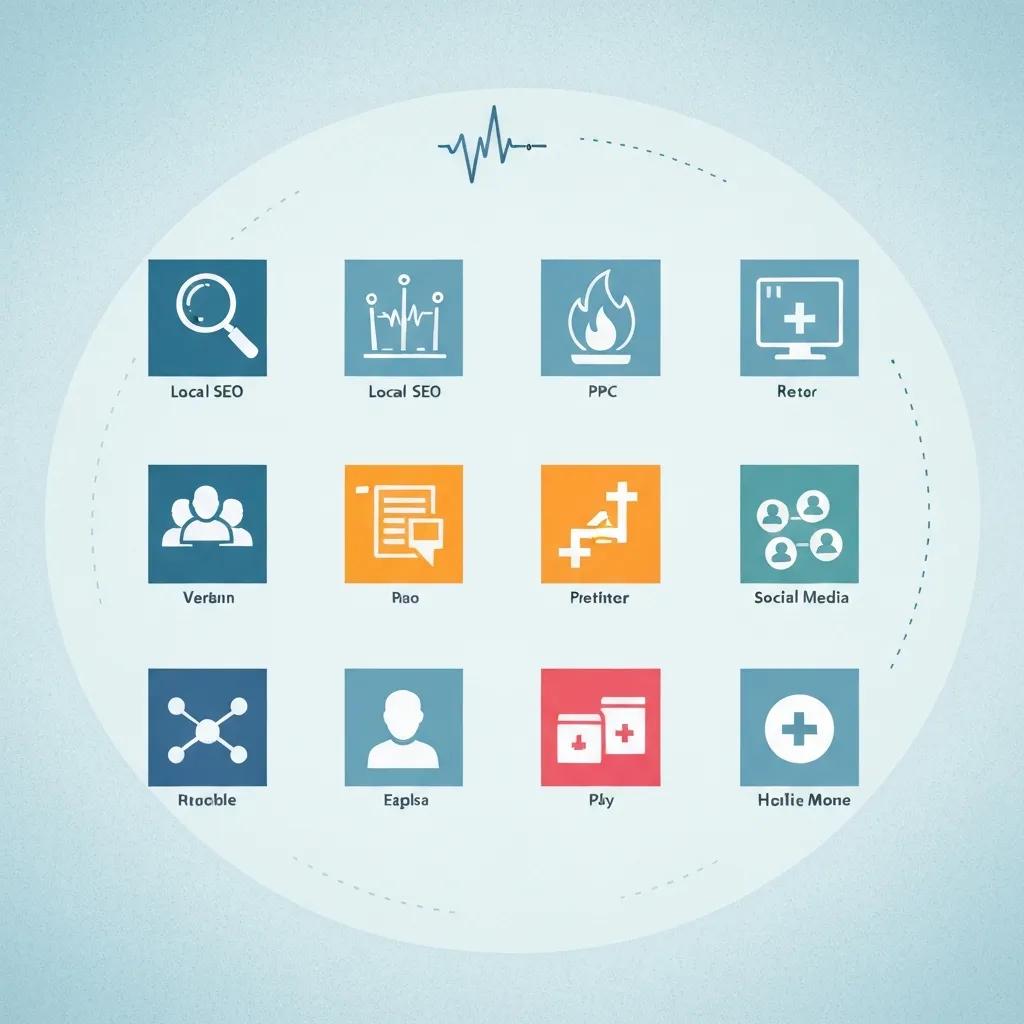
Most practices rely on a handful of primary channels—local SEO, PPC (Google Ads), paid social, content marketing, email and reputation management—each serving different stages of awareness, consideration and conversion. Local SEO captures “near me” discovery and typically delivers steady organic leads, while PPC gives controllable spikes for specific treatments. Paid social and content nurture patients and build familiarity, and email helps retention and rebooking. Reputation management (reviews and profile upkeep) directly lifts conversion rates at the decision point by increasing trust and click-through from local listings.
Those channel roles shape how attribution models allocate credit across touchpoints, which we cover next.
Which attribution models work best for medical practices in Australia?
Attribution models decide how conversion credit is split between touchpoints; the right model depends on practice size, conversion volume and how complex patient journeys are. First‑touch and last‑touch are simple and useful for clinics getting started, while linear, time‑decay and U‑shaped models add nuance for multi-step journeys. Data‑driven models give the most accurate allocation when you have enough tracked conversions and integrated data, but they need higher data quality and CRM matchbacks. Start with a clear, actionable model to fix obvious issues, then move toward data‑driven approaches as tracking and volume improve.
Below is a compact comparison of common models to help clinics pick a practical starting point.
The following table compares popular attribution models and suggests initial use‑cases for small medical practices.
| Attribution Model | Definition | Best-for (practice type/scenario) | Main drawback |
|---|---|---|---|
| First-touch | All credit to first recorded interaction | New clinic tracking initial discovery sources | Ignores later high‑intent touches |
| Last-touch | All credit to last interaction before conversion | Quick tests of landing pages and booking flow | Overvalues the final click or call |
| Linear | Equal credit across touches | Practices with short, multi‑step journeys | Treats all touches the same, which can dilute insight |
| Time-decay | More credit to recent touches | Campaigns where later nudges matter (reminders) | Needs consistent timestamped data |
| U-shaped (position-based) | Heavier credit to first and last touches | Local clinics balancing discovery and booking | Middle interactions can be undervalued |
| Data-driven | Algorithmic credit allocation based on your data | Larger clinics with integrated CRM and volume | Requires high-quality data and sample size |
This comparison helps clinics choose a pragmatic starting model and plan when to evolve to data‑driven attribution for deeper analytics.
What are the differences between first-touch, last-touch and multi-touch models?
First‑touch gives credit to the interaction that first introduced the patient, last‑touch credits the final interaction before booking, and multi‑touch splits credit across several interactions to reflect the full journey. A patient might click a paid ad, read a blog post, then call after seeing positive reviews—first‑touch favours the ad, last‑touch the review, while multi‑touch spreads credit across all three. The choice changes which channels look most valuable, so model different journeys to see how PAC and channel ROI shift and avoid overreacting to single‑touch metrics.
Understanding these differences leads to when clinics should consider data‑driven models, which we explain next.
How do data-driven attribution models enhance healthcare marketing?
Data‑driven attribution analyses conversion patterns to assign credit based on what actually moves patients through the funnel; that reveals non‑obvious contributor channels and improves ROI. For clinics, these models can surface the value of mid‑funnel content or repeated ad exposures that simple rules miss, helping you invest across awareness and conversion tactics. But they depend on enough conversions, a consistent UTM taxonomy, CRM matchbacks and clean event tracking—without those, outputs can be noisy or biased. Improve tracking quality and integrate booking data before switching to data‑driven attribution so insights are reliable and actionable.
With models compared, the next section shows how to calculate patient acquisition cost and measure ROI with worked examples and local benchmarks.
How do you calculate patient acquisition cost and ROI for healthcare marketing?

Patient Acquisition Cost (PAC) measures how much marketing spend is needed to get a new patient: total campaign or channel spend divided by the number of new patients attributed to that spend. PAC is useful when compared to treatment revenue, contribution margin and Customer Lifetime Value (CLV): a low PAC that brings low CLV may be worse than a higher PAC channel that attracts repeat, high‑value patients. Track channel‑level PAC to spot outliers, use a consistent attribution model, and reallocate toward channels with favourable CLV:PAC ratios. This section gives formulas and benchmark‑style examples for dental, chiropractic and physiotherapy clinics in Australia.
The formula and a worked example below are designed for clinic owners who want a quick calculation to apply to their reports.
What is the formula for Patient Acquisition Cost in Australian practices?
The basic PAC formula is: PAC = Total marketing spend (for period or channel) ÷ Number of new patients attributed (same period). For example, if a dental clinic spends $6,000 on paid search and attribution assigns 30 new patients to that channel in a month, PAC = $6,000 ÷ 30 = $200 per new patient. Track channel‑level PAC alongside average treatment revenue and retention to judge profitability; a $200 PAC might be fine for high‑margin restorative work but too high for routine low‑margin visits. Use consistent attribution windows and match CRM booking dates to marketing events to avoid timing mismatches that inflate PAC.
This worked example feeds into the channel benchmark comparisons in the table below.
| Channel | PAC Formula Example | Typical AU Benchmark (dentistry/chiro/physio) | Notes |
|---|---|---|---|
| Google PPC | $3,000 ÷ 20 = $150 | Dentistry: $150–$400 | Higher for specialised dentistry keywords |
| Local SEO | $1,200 (monthly SEO) ÷ 10 = $120 | Chiro: $100–$250 | Organic maturation over months |
| Reputation/Referrals | $0 (maintenance cost) ÷ 8 = $0–$50 | Physio: $80–$220 | Reviews lift conversion rates, lowering direct spend |
Use this benchmark table as context when you calculate channel PAC and compare performance against typical ranges, keeping in mind variation by treatment complexity and local competition.
How can ROI be measured across different marketing channels?
Channel ROI quantifies financial return after attributing revenue to channels and adjusting for contribution margin. Use Campaign ROI = (Revenue attributed − Cost) ÷ Cost. In practice, attribute appointment revenue or a share of treatment revenue to channels per your chosen model, subtract direct marketing cost, and divide by cost to see profitability. Also calculate lifetime ROI by including CLV, since some channels bring long‑term patients whose cumulative value exceeds the initial PAC. Different attribution models change the numerator, so compare models consistently and prioritise channels that improve both short‑term contribution and long‑term patient value.
Those measurement practices lead naturally to the KPIs clinics must track to operationalise attribution and ROI, covered next.
What are the key performance indicators to track marketing channel performance in healthcare?
The right KPIs tie marketing activity to patient outcomes and feed directly into attribution: track PAC, conversion rate, CLV, cost per lead (CPL), lead‑to‑patient rate and channel ROI. Capturing these KPIs needs digital event tracking (form submits, booking clicks), call‑tracking and CRM matchbacks so offline conversions are included. Interpret KPIs within your attribution framework—for example, a channel with low CPL but a poor lead‑to‑patient rate may look good early in the funnel but perform badly on PAC—so use multiple metrics for a fuller picture. Review KPIs regularly—weekly for live campaigns, monthly for attribution reports—to spot trends, seasonality and changes in reputation or local competition.
The table below clarifies each KPI, how to measure it and why it matters for attribution-driven decisions.
| KPI | What it measures | How to track it | Why it matters for attribution |
|---|---|---|---|
| Patient Acquisition Cost (PAC) | Cost per new patient | Spend ÷ attributed new patients via CRM | Primary efficiency metric for channel allocation |
| Conversion Rate | Share of leads that book | Forms, calls, bookings tracked by event | Reveals landing page and booking friction |
| Customer Lifetime Value (CLV) | Revenue from a patient over time | Average treatment value × retention | Contextualises acceptable PAC |
| Cost per Lead (CPL) | Cost to generate an enquiry | Spend ÷ leads (forms or calls) | Early funnel efficiency indicator |
| Lead-to-Patient Rate | Leads that convert to booked patients | CRM follow-up and booking data | Bridges marketing leads to actual appointments |
This KPI table helps clinics prioritise which metrics to collect and how they contribute to accurate attribution and smarter budget decisions.
Which KPIs best reflect marketing effectiveness for dental, chiropractic and physiotherapy clinics?
Different practice types emphasise different KPIs: dental clinics often prioritise PAC for high‑value treatments, chiropractic clinics focus on lead‑to‑patient rate and retention, and physiotherapy clinics monitor CLV and repeat‑visit frequency. For dentistry, track treatment revenue per patient and new‑patient PAC; for chiro, measure initial consultation conversion and ongoing bookings per patient; for physio, emphasise rehabilitation package uptake and retention weeks. Measurement tips: enable call‑tracking to capture phone bookings, sync booking systems with your CRM for matchbacks, and use consistent UTM naming so channel attributions are reliable. Those KPI combinations give practice owners actionable insight into which channels move the business needle.
Next we cover how conversion rates and CLV shape attribution decisions.
How do conversion rates and customer lifetime value influence attribution?
Conversion rates and CLV change how you should value channels: a channel with a low conversion rate but high CLV may be undervalued by last‑touch models, while high conversion but low CLV channels can look attractive yet be weak long term. For example, a low‑cost awareness channel that brings patients who return for high‑margin treatments deserves more credit than single‑visit low‑value leads. Use CLV‑adjusted ROI and consider multi‑touch attribution that recognises channels contributing to retention and rebooking. Combining conversion rate and CLV analysis lets clinics set CLV:PAC targets and optimise spend for sustainable growth.
Next, practical implementation steps for accurate attribution tracking in clinics.
How can healthcare practices implement effective attribution tracking?
Effective attribution tracking needs a practical tech stack, a clear UTM taxonomy, CRM integration for matchbacks and a regular analysis cadence—each step closes the gap between online behaviour and offline bookings. Start with a basic stack—GA4 for site analytics, Google Ads for paid search, a CRM that records bookings, and call‑tracking for phone leads—then scale to server‑side tagging and deeper integrations as capability grows. Data hygiene is essential: define priority conversions, standardise UTMs, and ensure events map cleanly into the CRM so attribution models get reliable inputs. Governance steps include monthly attribution reviews, model benchmarking and documented reporting definitions so clinical stakeholders interpret results consistently.
Below is a practical tool‑stack comparison to help clinics pick a starting stack and an advanced stack as they scale.
| Tool | Feature | Application |
|---|---|---|
| GA4 | Event-based tracking | Capture site events, conversions and funnels |
| CRM | Booking and patient records | Match marketing leads to booked patients |
| Call-tracking | Phone call attribution | Attribute inbound calls to campaigns |
| Google Ads | Paid search and remarketing | Drive targeted acquisition and test offers |
This tool comparison shows which systems form the core implementation components and how they work together to enable robust attribution.
After outlining the toolset and setup checklist, many clinics find external partners useful for implementing and managing analytics and reporting. Milkcan Marketing offers Analytics & Reporting as part of its services and works with small dental and healthcare practices to integrate tracking, reporting and channel analysis. As an Australia‑based specialist for small healthcare practices, Milkcan aligns local SEO, PPC, reputation and analytics work to clarify attribution and surface patient acquisition drivers; clinics that want support typically start with an audit to find tracking gaps and a reporting plan to measure PAC and ROI more reliably. With those partnership options in mind, the next subsection lists concrete best practices for setup and ongoing analysis.
What tools and platforms support marketing attribution in medical practices?
Core tools include Google Analytics 4 for event capture, a CRM for booking matchbacks, call‑tracking for phone conversions and ad platforms (Google Ads, social) for paid media measurement—each maps a piece of the patient journey. For low‑budget clinics, GA4 + CRM + simple call‑tracking covers most needs; advanced setups add server‑side tagging, call analytics and automated matchbacks to improve reliability. Pros and cons: GA4 is flexible but needs correct event configuration, CRMs centralise bookings but require consistent field use, and call‑tracking captures offline conversions but must be integrated to avoid duplicates. Choose the stack based on clinic volume, internal analytics capacity and willingness to invest in clean data.
This prepares clinics for the concrete tracking steps that follow.
What are best practices for setting up conversion tracking and data analysis?
Start with a clear UTM taxonomy and event naming aligned to CRM fields so each web or ad interaction can be matched to a booked appointment. Define primary conversion events (booked appointment, phone booking) and secondary events (form submits, click‑to‑call, content downloads) and map them to revenue where possible. Reconcile CRM and analytics regularly to find mismatches. Establish reporting cadence—weekly campaign checks, monthly attribution reports and quarterly strategy reviews—and document conversion definitions and attribution windows to keep reporting consistent. Finally, protect privacy and compliance: minimise personal data in analytics and ensure any matchbacks follow local privacy guidance while keeping data quality high for reliable attribution.
With tools and setup covered, the final section shares real examples and lessons clinics can copy.
What are real-world examples of successful marketing attribution in Australian healthcare?
Real attribution wins start with better tracking, a pragmatic model and small experiments that reveal where value actually comes from. Common patterns include fixing UTM inconsistencies to show organic local listings outperform paid search, adding call‑tracking to capture previously invisible phone bookings, and using CRM matchbacks to measure patient value rather than leads alone. Those changes let clinics shift budgets away from low‑retention channels toward ones that drive higher CLV, demonstrating the practical ROI of disciplined attribution and analytics. The examples below extract repeatable actions small practices can test quickly to improve attribution clarity and PAC.
The examples include brief notes on how an agency partner can support attribution work using only explicitly allowed service descriptions.
How has Milkcan Marketing improved ROI and patient acquisition through attribution?
Milkcan Marketing, an Australia‑based agency focused on small dental and healthcare practices, aligns local SEO, digital advertising, reputation management and analytics & reporting to help clinics see which channels deliver patients. Their Analytics & Reporting service supports CRM matchbacks and performance dashboards so clinics can view channel‑level PAC and conversion paths more clearly, enabling data‑driven budget changes. By combining local growth tactics and campaign management with transparent reporting, Milkcan helps clinics prioritise channels that deliver sustainable patient acquisition and local visibility gains. Many practices start with an audit to identify tracking gaps and a reporting plan to measure PAC and ROI more reliably.
These service‑aligned stories show processes clinics can run in‑house or with a partner to improve attribution clarity.
What lessons can small healthcare practices learn from attribution success stories?
Small practices can replicate attribution wins by focusing on a few high‑impact changes: standardise UTMs, enable call‑tracking, sync bookings into a CRM and pick a pragmatic attribution model to start testing. Run channel‑level experiments—move 10–20% of budget from a weak channel to a suspected high‑performer—and measure PAC and lead‑to‑patient rates before making larger shifts. Prioritise data quality: consistent naming, timely CRM matchbacks and monthly reconciliation stop noisy signals that mislead decisions. Keep experiments small, document results, and iterate so attribution improvements compound without disrupting patient care.
Frequently Asked Questions
What challenges do small healthcare practices face with marketing attribution?
Small clinics usually face a few consistent challenges: patient journeys are multi‑channel, offline interactions (phone calls, in‑person visits) often go untracked, and limited resources or analytics skills make robust attribution hard to implement. These factors can hide which channels actually deliver patients and make optimisation decisions risky without better tracking.
How can clinics ensure accurate tracking of offline conversions?
Capture offline conversions with call‑tracking that links phone enquiries to campaigns—use unique numbers per channel or campaign where practical. Integrate your CRM with analytics to enable matchbacks between leads and booked appointments, and reconcile CRM and analytics data regularly to catch discrepancies. These steps significantly improve attribution accuracy for phone and in‑person bookings.
What role does patient feedback play in marketing attribution?
Patient feedback helps attribution by revealing which channels drive trust and decision‑making. Reviews and testimonials can show which touchpoints influenced patients, and analysing feedback highlights strengths and weaknesses across channels. That insight supports reputation management and can increase conversion rates where it matters most.
How often should clinics review their marketing attribution strategies?
Review attribution regularly—monthly is a practical cadence for most clinics. Monthly checks let you spot short‑term shifts and campaign issues, while quarterly or biannual strategic reviews give a longer view for planning and budget allocation. Keep weekly checks for active campaigns that need close monitoring.
What are the benefits of using a multi-touch attribution model?
Multi‑touch attribution gives a fuller view of the patient journey by distributing credit across multiple interactions. Unlike single‑touch models, it recognises the cumulative influence of your marketing mix, helping you make more informed budget and strategy decisions that balance awareness and conversion tactics.
How can clinics improve their marketing ROI through attribution?
Improve ROI by identifying channels with the best PAC and CLV and reallocating budget accordingly. Use experiments (A/B tests), measure outcomes consistently, and track KPIs like PAC, CPL and lead‑to‑patient rate. Regularly review results and prioritise channels that deliver both short‑term contribution and long‑term patient value.
Conclusion
Clear marketing attribution lets clinics allocate budget with confidence and improve patient acquisition outcomes. By understanding which channels drive value and by measuring PAC alongside CLV, clinics can make data‑driven choices that boost ROI and support sustainable growth. Start with sensible tracking, pick a pragmatic attribution model, and iterate—small improvements add up. If you want tailored help, consider an audit and reporting plan to turn your data into practical decisions.