Optimise Dental Landing Pages for SEO and Local Patient Conversions
Dental service landing pages are focused web pages designed to match search intent, convert visitors into booked patients, and support SEO by signalling topical relevance to search engines. By aligning service-specific copy, local signals, and conversion-focused design, these pages reduce friction in the patient journey and amplify local visibility for target queries such as “dental implant landing page” or “emergency dentist landing page”. This guide shows how to build and optimise dental landing pages that increase dental website traffic and patient acquisition while retaining compliance with healthcare marketing best practice. You will learn why landing pages matter for SEO and conversions, the core elements every page must include, advanced SEO tactics including structured data, CRO methods to lift conversions, content strategy with video and FAQ schema, and measurement approaches to iterate continuously. Throughout we weave practical, Australia-relevant guidance for local SEO for dentists and concrete steps you can apply to improve patient conversions and local pack performance.
Why Are High-Converting Dental Landing Pages Essential for SEO and Patient Growth?
High-converting dental landing pages are specialised pages that match user intent, funnel qualified traffic, and convert visitors into measurable patient leads by combining targeted content, UX, and local relevance. They work because search engines reward pages that satisfy intent with lower bounce rates and higher user engagement, which in turn improves local SEO performance and organic visibility. Converting visitors directly affects patient acquisition metrics, linking organic sessions to bookings and phone calls that determine practice ROI. Effective landing pages also support site architecture by concentrating topical authority on specific services, which helps broader site rankings. The next subsection explains how these pages directly improve SEO signals for dental practices.
How Do Dental Landing Pages Improve SEO for Dental Practices?
Dental landing pages improve SEO by providing tightly focused, intent-matched content that aligns keywords, meta elements, and on-page structure to what patients search for. This mechanism reduces bounce and increases dwell time, while clear H tags and contextual internal links distribute authority across a practice website. Implement title/meta templates that include service + locality for higher click-through rates, and place keyword-targeted content in the first 100 words to signal relevance. These changes enhance topical authority for service clusters and make it easier for search engines to match pages to specific searches. Understanding these optimisation mechanics sets up the need for robust local signals, which we cover next.
What Role Does Local SEO Play in Dental Landing Page Success?
Local SEO drives qualified, nearby patients by aligning landing page content with Google Business Profile attributes, suburb-level keywords, and consistent local citations that reinforce relevance to locale-specific queries. The mechanism is simple: Google uses GBP signals, citations, and review patterns to rank local service pages in the local pack, so landing pages must mirror GBP descriptions and service attributes. Use suburb + service headings and mention nearby landmarks or suburbs naturally to capture “near me” search behaviour, and ensure NAP consistency in citations. Strong local signals increase page relevance for geographically constrained queries, which leads into mobile-first design considerations for on-the-go patients.
Why Is Mobile-First Design Critical for Dental Landing Pages?
Mobile-first design is critical because most patients search for local dental services on mobile devices and expect fast, touch-friendly booking experiences that convert immediately. Mobile optimisation reduces friction through simplified CTAs, click-to-call buttons, and concise forms, while prioritising page speed and compressed images to avoid abandonment. A responsive layout with prominent primary actions above the fold increases phone calls and booking widget interactions and accelerates local conversions. Addressing mobile UX directly improves both conversion metrics and mobile search rankings, which prepares the site for deeper landing page element design covered next.
What Are the Core Elements of Effective Dental Landing Pages?
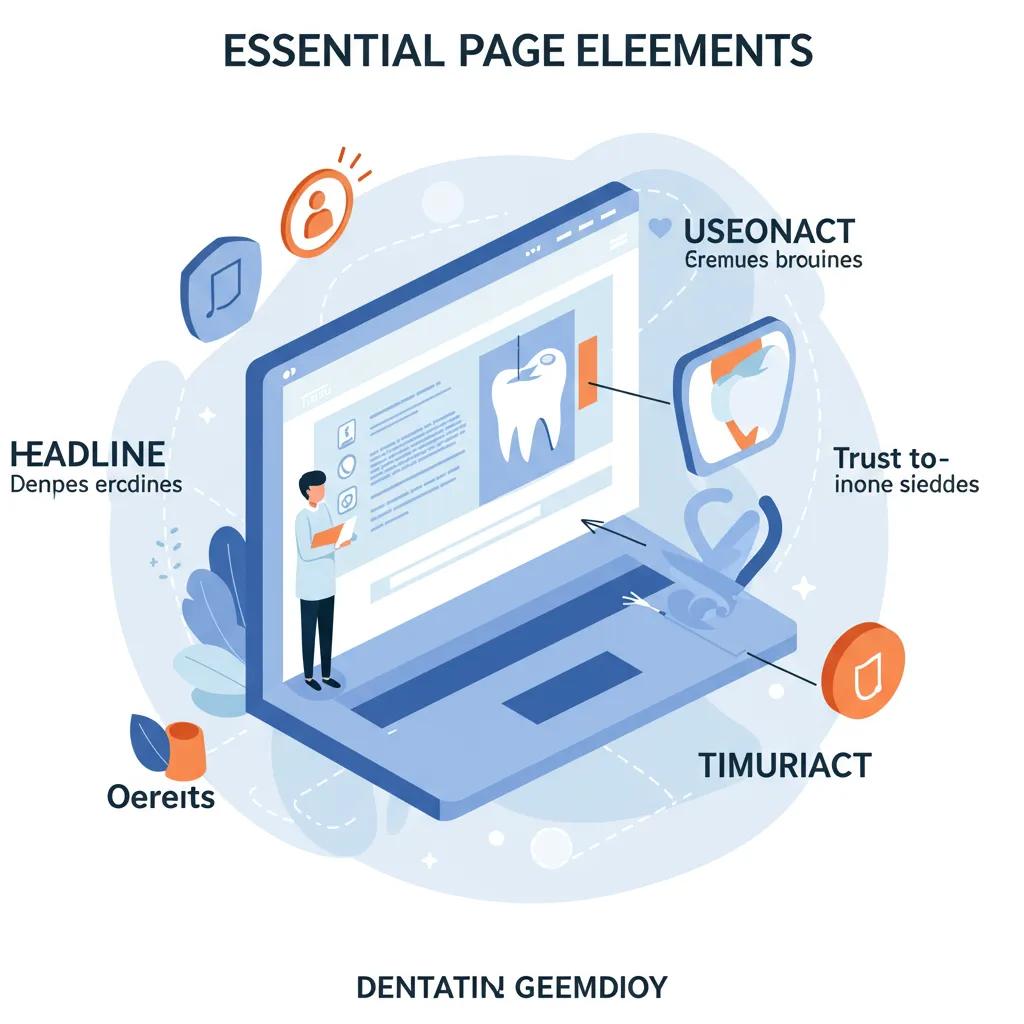
Core landing page elements are the structural and trust-building components that directly support conversions: a clear headline, unique value proposition, focused CTA, relevant visuals, trust signals, and an optimised lead capture form. Each element addresses a specific psychological or technical barrier — headline captures intent, visuals build rapport, trust signals reduce anxiety, and forms collect actionable lead data. Designing these elements in a patient-centred sequence increases form completion rates and supports search engines’ evaluation of user satisfaction. The following table compares each element to its purpose and a best practice to implement.
Different landing page elements serve distinct roles and require specific execution to drive conversions.
| Element | Purpose | Best practice |
|---|---|---|
| Headline | Capture user intent and promise a benefit | Use service + benefit + locality formula in H1 |
| Call-to-action (CTA) | Direct the next step and reduce decision friction | Single primary CTA with urgency or availability cue |
| Visuals | Build rapport and reduce treatment anxiety | Use team photos or short testimonial clips with consent |
| Trust signals | Reduce perceived risk | Display reviews, accreditations, and ratings prominently |
| Lead capture form | Convert intent into a lead | Keep to essential fields and offer click-to-call alternate |
This table clarifies how each element contributes to conversions and which practice delivers the most consistent uplift. Next, we break down headline and CTA crafting in detail.
How to Craft Compelling Headlines and Clear Calls-to-Action for Dentists?
A compelling headline defines the service, states the key benefit, and, when relevant, includes locality to match search intent; the CTA then prompts a single, clear action that removes ambiguity. Use headline formulas such as “Service — Benefit in X visits” or “Emergency dentist in [Suburb] — Same-day appointments” to match queries. CTAs should prioritise one action (book online, call now) and incorporate availability cues like “Limited slots this week” to increase urgency. Test variations by swapping locality, benefit emphasis, and CTA wording to find the highest-performing combinations. These headline and CTA refinements naturally lead into selecting visuals and trust signals that support the message.
Which Visuals and Trust Signals Boost Patient Confidence on Landing Pages?
Appropriate visuals and trust signals alleviate dental anxiety and signal credibility, improving conversion propensity by establishing rapport before a practice interaction. Use professional team photos, short video testimonials, and before/after imagery with documented consent, ensuring alt text includes semantic keywords for accessibility and SEO. Prominently display review summaries, accreditation badges, and concise patient quotes near the primary CTA to reduce friction. Balance visual richness with page speed optimisation to keep mobile performance high. Designing trust signals this way transitions naturally into form design, where low friction completes the conversion pathway.
How Should Lead Capture Forms Be Designed for Maximum Patient Engagement?
Lead capture forms should collect only essential information to reduce abandonment while offering alternatives such as click-to-call and online booking widgets for users who prefer immediate action. Recommended fields for booking intent include name, preferred date/time, phone, and a single field for treatment reason; for enquiries, include email and a brief message field. Use progressive profiling for repeat visitors, include a brief privacy reassurance line, and show trust seals near the submit button to increase confidence. Offer micro-conversions such as “request a callback” or “check appointment availability” to capture intent from hesitant visitors. Effective form design connects directly to technical SEO and schema choices discussed next.
How Can Advanced SEO Techniques Optimise Dental Service Landing Pages?

Advanced SEO techniques combine semantic keyword research, technical improvements, and local strategies to increase both visibility and conversion likelihood for dental landing pages. These tactics work by improving indexability, clarifying intent to search engines, and leveraging structured data to enable rich results that increase click-through rate. Focus on semantic clusters that map to patient intent, implement Schema.org types for Service and LocalBusiness, and fix technical obstacles like slow images or improper canonicalisation. The EAV table below helps prioritise keyword types and expected impacts for implementation planning.
Use the following comparison to prioritise keyword work across landing pages and site structure.
| Keyword Type | Where to Use | Expected Impact |
|---|---|---|
| Transactional long-tail (e.g., “dental implant [suburb]”) | Title, H1, meta, hero copy | High intent, immediate bookings |
| Informational (e.g., “what to expect dental implant”) | FAQ, body copy, blog links | Medium impact, builds trust |
| Brand + service | GBP service attributes, contact sections | Supports local pack and brand clicks |
| Voice-conversational phrases | FAQ and FAQ schema short answers | Captures voice queries and PAA boxes |
This prioritisation clarifies which keyword placements drive bookings versus long-term authority. Next, we outline tactical keyword and semantic optimisation strategies for dentists.
What Are the Best Keyword Research and Semantic Optimisation Strategies for Dentists?
Effective keyword strategy maps patient intent to page purpose by grouping transactional, informational, and local queries into semantic clusters that each landing page satisfies. Start with service-specific long-tail keywords and expand to related questions commonly seen in PAA and voice searches, then place primary keywords in title, H1, and early body text. Use latent semantic variations and related entities like “Google Business Profile” and “Local Business Schema” within content to strengthen topical authority. Internal linking from high-authority pages to service landing pages transfers relevance and helps indexation, which in turn supports CRO experiments described later.
How Does Technical SEO Enhance Dental Landing Page Performance?
Technical SEO improves ranking potential and user experience by ensuring fast load times, correct indexability, and structured-data implementation for rich results. Key tasks include compressing images and lazy-loading video, verifying canonical tags and sitemaps, and implementing Service, FAQPage, and LocalBusiness schema to surface rich snippets. Tools such as Google Search Console and heading-structure audits identify crawl issues that reduce visibility, and fixing these issues directly increases potential organic traffic. These technical improvements support local optimisation tactics that follow.
Implementing structured data can significantly improve how search engines understand and display your website’s information.
White Hat SEO: Employing Structured Data for Improved Website Comprehension
“White hat” search engine optimisation refers to the practice of publishing web pages that are beneficial to users, whilst enabling search engines and web applications to better understand the structure and content of your website. This article demonstrates how to incorporate structured data into your website, thereby allowing search engines to more readily connect users with your library’s locations, opening hours, and contact details. A web page for a branch of the Greater Sudbury Public Library, accessed in January 2015, serves as the foundation for examples that progressively enhance the page with structured data. Ultimately, some of the benefits that structured data facilitates beyond search engine optimisation are examined.
White hat search engine optimization (SEO): Structured web data for libraries, D Scott, 2015
How to Implement Local SEO Strategies for Australian Dental Practices?
Local SEO for Australian practices emphasises Google Business Profile optimisation, consistent local citations, and hyperlocal landing pages for suburbs or procedures to capture nearby intent. Steps include aligning landing page service descriptions with GBP attributes, soliciting and managing reviews, building consistent citations, and creating suburb-specific pages that include regional language and relevant suburb names. Prioritise GBP fields such as service attributes and categories, and use local backlink sources such as regional directories or community sites to strengthen authority. Implementing these local steps increases local pack visibility and sets up A/B testing for conversion improvements discussed in the next section.
What Conversion Rate Optimisation Techniques Increase Dental Landing Page Success?
CRO techniques for dental landing pages improve the percentage of visitors who complete desired actions by using structured tests, personalisation, and optimised follow-up workflows to capture and nurture leads. These techniques work by systematically identifying friction points, testing high-impact changes, and using analytics to prioritise experiments. Start with hypotheses around headline, CTA placement, and form length, then run A/B tests with clear KPIs. Below is a practical list of A/B test ideas to accelerate improvements.
Here are high-impact A/B tests to prioritise on dental landing pages.
- Headline variation: Service + benefit vs service + locality.
- CTA experiment: “Book Online” vs “Call for Same-Day” above the fold.
- Form length: Minimal fields vs extended intake form with progressive profiling.
- Social proof placement: Reviews near CTA vs reviews lower in page.
These tests generate learnings that feed into personalisation and follow-up workflows described next.
How to Use A/B Testing and Analytics to Improve Dental Landing Pages?
A/B testing improves conversions by comparing controlled variations and measuring changes in KPI metrics such as conversion rate and phone clicks, using tools like GA4 event tracking and heatmaps to interpret results. Define a primary metric (e.g., booking conversion rate), power your tests adequately, and prioritise experiments with high expected impact and low development cost. Use heatmaps to detect attention gaps and session recordings to identify form friction, then iterate by implementing winning variants and testing secondary hypotheses. Proper test governance ensures learnings accumulate and guide future landing page versions.
What Personalisation and User Journey Mapping Strategies Work for Dentists?
Personalisation increases relevance by tailoring content to referral source, service interest, or geography, and user journey mapping ensures messaging aligns with typical patient decision stages from research to booking. Implement simple source-based personalisation such as hero copy that changes for paid ads versus organic visitors, or show suburb-specific CTAs for users from local pages. Map top personas — emergency, cosmetic, implant patients — and design tailored micro-conversions and follow-up sequences for each segment. Personalisation should be lightweight to avoid adding latency, and it links directly to optimised lead capture and follow-up systems discussed next.
How to Optimise Lead Capture and Follow-Up for Dental Patient Conversion?
Optimise lead capture and follow-up by combining fast response targets, multi-channel sequences, and CRM integration to convert initial enquiries into appointments. Set response-time targets (e.g., initial contact within 1 business day), automate confirmation messages and reminders, and route leads in the CRM by service type to the appropriate clinician or booking desk. Use micro-conversion tracking for phone-clicks and booking widget interactions to measure engagement pathways. Well-orchestrated follow-up increases booked appointments and builds a repeatable process for converting website traffic into measurable patient growth.
How Does Content Strategy Enhance Dental Landing Page Effectiveness?
Content strategy elevates landing pages by using persuasive, patient-focused copy, strategic video assets, and FAQ content with schema to capture both PAA results and voice-search traffic. Good content reduces anxiety, addresses objections, and provides clear next steps, which directly improves conversion rates while supporting topical authority for SEO. Use video testimonials and procedural explainers to increase trust and time on page, and structure FAQ content to answer common voice queries succinctly. The following list outlines core content assets that a robust landing page strategy should include.
Core content assets for high-performing dental landing pages:
- Short hero video or animated explainer (10–30 seconds).
- Patient testimonial clips and captions with transcripts.
- Concise FAQ blocks targeting question-style search queries.
- Detailed procedure pages linked as supporting content for topical authority.
These assets work together to improve relevance and conversion; next we provide copywriting best practices that reduce patient anxiety and drive action.
What Are the Best Practices for Crafting Persuasive Copy for Dental Services?
Persuasive copy for dental services leads with benefits and empathy, explains the process simply, and answers common objections to reduce anxiety and build trust. Start hero copy with a clear statement of the service and patient benefit, then describe the patient journey and expected outcomes in concise bullets. Use evidence-based language, include social proof near actions, and close with a simple CTA that restates the next step. This structure supports both human readers and search engines by matching intent and increasing time on page.
How to Integrate Video Testimonials and Procedural Videos on Landing Pages?
Video testimonials and short procedural demos demonstrate outcomes and process transparency, increasing conversions by addressing emotional barriers and clarifying expectations. Place a short testimonial above the fold or beside the CTA and deeper procedural demos in a “how it works” section; always include captions, short transcripts, and optimised thumbnails to aid accessibility and SEO. Host videos on a fast CDN or embed carefully to preserve page speed, and track engagement using analytics events. Proper video placement complements FAQ schema and strengthens rich-result opportunities covered next.
Why Is FAQ Content and Schema Markup Important for Dental Landing Pages?
FAQ content and FAQPage schema increase the chance of rich snippets, capture PAA and voice queries, and provide concise answers that satisfy immediate patient questions while reducing support friction. Implement short, direct Q&A entries focused on common patient concerns and mark them with FAQPage schema so search engines can surface answers in SERPs. Keep answers under 40–50 words when possible for snippet eligibility, and update FAQs based on query data from Google Search Console. Using FAQ schema supports voice search optimisation and sets up measurable content improvement cycles in analytics.
How to Measure Success and Continuously Improve Dental Landing Pages?
Measuring success requires a clear KPI framework, event tracking in analytics tools, and a cadence for audits and optimisation to ensure landing pages remain effective over time. KPIs connect traffic quality to business outcomes: organic sessions, booking conversion rate, phone calls, and local pack impressions are primary indicators. Use GA4 for event tracking, Google Search Console for query insights, and Google Business Profile metrics to monitor local engagement. The EAV table below maps key metrics to tools and recommended targets for baseline measurement.
This KPI mapping clarifies which metrics to prioritise and which tools to use when measuring landing page performance.
| Metric | Tool | Target/Benchmark |
|---|---|---|
| Organic sessions to landing pages | GA4 / GSC | Steady month-on-month growth of 5–15% |
| Booking conversion rate | GA4 event tracking | 3–8% depending on service and traffic source |
| Phone calls (click-to-call) | GA4 / GBP insights | Increase click-to-call by 10% after CTA optimisation |
| Local pack impressions | Google Business Profile / GSC | Improve impressions by optimising GBP attributes |
This table helps practices set realistic monitoring baselines and focus optimisation efforts. Next, we describe practical analytics implementation steps.
What Key Performance Indicators Should Dental Practices Monitor?
Dental practices should monitor KPIs that link traffic quality to patient outcomes: organic sessions, conversion rate, booked appointments, phone call volume, and local pack visibility. Each KPI has a purpose: organic sessions show visibility, conversion rate measures page effectiveness, phone calls capture high-intent contacts, and GBP interactions show local engagement. Set targets per metric and review trends monthly to detect issues or opportunities. With KPI clarity, the next step is configuring analytics to capture these signals accurately.
How to Use Analytics Tools to Track Dental Landing Page Performance?
Use GA4 events for form submissions, booking completions, and CTA clicks; configure Search Console to monitor queries and impressions; and consult Google Business Profile insights for local engagement metrics. Implement event-based tracking with clear naming conventions (e.g., landing_booking_submit) and build dashboard widgets that combine sessions, conversions, and top queries. Regularly export top-performing queries and pages to guide content refresh priorities. Robust tracking enables data-driven CRO experiments and content updates on an iterative cadence.
When and How Should Dental Landing Pages Be Updated for SEO and CRO?
Update landing pages on a cadence: minor content and CRO tweaks quarterly, full technical and content audits annually, and immediate updates when services change or new PAA questions emerge. Use signals such as declining conversions, drops in local pack impressions, or new competitor activity to trigger ad-hoc updates. Execute updates by combining performance data, fresh keyword research, and test learnings, then remeasure impact. Regular updates ensure pages stay aligned with search behaviour and patient expectations, preparing practices for emerging 2025 trends discussed next.
What Are the Latest Trends and Innovations in Dental Landing Page SEO for 2025?
Key 2025 trends for dental landing pages include AI-assisted content workflows, increased importance of voice search, and stronger emphasis on mobile-first, localised experiences shaped by regional patient behaviour. These innovations improve production speed, personalise user experiences, and enable richer SERP features via structured data. Practices should adopt AI for draft generation and testing while enforcing human review to maintain expertise and trust. The next subsection explains practical AI uses alongside quality controls.
How Is AI Changing Dental Landing Page Content and Personalisation?
AI accelerates content drafting, semantic clustering, and personalised variations by generating first-pass copy and suggesting keyword clusters, while human editors ensure clinical accuracy and trust signals are preserved. Use AI to create A/B test variants, summarise review themes for social proof, and identify micro-personalisation triggers from analytics. Maintain E-E-A-T by reviewing AI outputs for factual accuracy and adding clinician-authored sections where necessary. AI can scale experimentation but must be used under editorial governance to protect patient trust.
Why Is Voice Search Optimisation Becoming Crucial for Dental Practices?
Voice search optimisation matters because conversational queries are rising, especially for local, urgent dental needs, and FAQ schema with concise answers increases the likelihood of appearing in voice responses. Structure content in question-answer format and include short, direct responses that match natural speech patterns; include locality cues for queries like “where is the nearest emergency dentist near [suburb]”. Tracking voice-relevant queries in Search Console helps refine FAQ content and schema to capture voice traffic effectively.
How Do Australian Market Insights Influence Dental Landing Page Strategies?
Australian market dynamics emphasise suburb-level targeting, Google Business Profile prioritisation, and clear patient communications that reflect local regulatory expectations and consumer behaviour. Prioritise hyperlocal landing pages for suburbs with high search demand and align GBP attributes with local service offerings. Use Australian phrasing and local examples in copy to resonate with patients and strengthen local backlink opportunities. These regional adaptations increase relevancy and conversion for Australian dental practices and provide a roadmap for implementation support.
Milkcan Marketing combines localised expertise with a holistic online presence approach to help dental practices implement many of the tactics described above, including local SEO, Google Business Profile management, reputation management, and content marketing. For practices seeking implementation support or an audit of landing page performance, Milkcan Marketing can review local SEO and technical elements and recommend prioritised actions to increase patient acquisition. If you would like an audit or guidance tailored to Australian dental practices, consider reaching out to Milkcan Marketing to enquire about services and next steps.