On-Page SEO Essentials for Dental Websites: Grow Local Patients
On-page SEO for dental websites involves tailoring every page element—content, HTML tags, structured data, and technical performance—so Google and patients find, trust, and convert your practice. This guide explains what on-page SEO entails, why it drives local patient discovery, and how specific changes increase clicks, enquiries, and bookings for dental clinics. Many dental practices miss opportunities in content structure, Core Web Vitals, and local signals that directly reduce visibility for high-intent local searches; this article provides step-by-step tactics to fix those gaps. You will learn the most important on-page factors, content strategy and service-page templates, technical priorities like site speed and Core Web Vitals, local optimisation including Google Business Profile and schema markup, plus UX and monitoring workflows. Practical lists, copy-paste schema examples, and EAV comparison tables make technical implementation accessible for clinicians and practice managers. Read on to convert organic visibility into measurable patient growth while aligning pages with modern E-E-A-T and local SEO expectations.
What Are the Most Important On-Page SEO Factors for Dental Clinics?
On-page SEO factors are the page-level elements that determine how well a dental site satisfies user intent, how clearly search engines understand the content, and how quickly and reliably the page loads. These factors work together: relevant, authoritative content signals expertise and trust; HTML elements (titles, headings, meta) communicate topical focus to search engines; technical performance and UX determine engagement and conversion rates. Prioritising these elements increases visibility for local searches, improves click-through rates, and supports patient acquisition. The next subsections break down elements by impact, translate SEO work into patient acquisition outcomes, and list common mistakes to avoid while introducing corrective steps.
Which On-Page Elements Impact Dental SEO Rankings the Most?
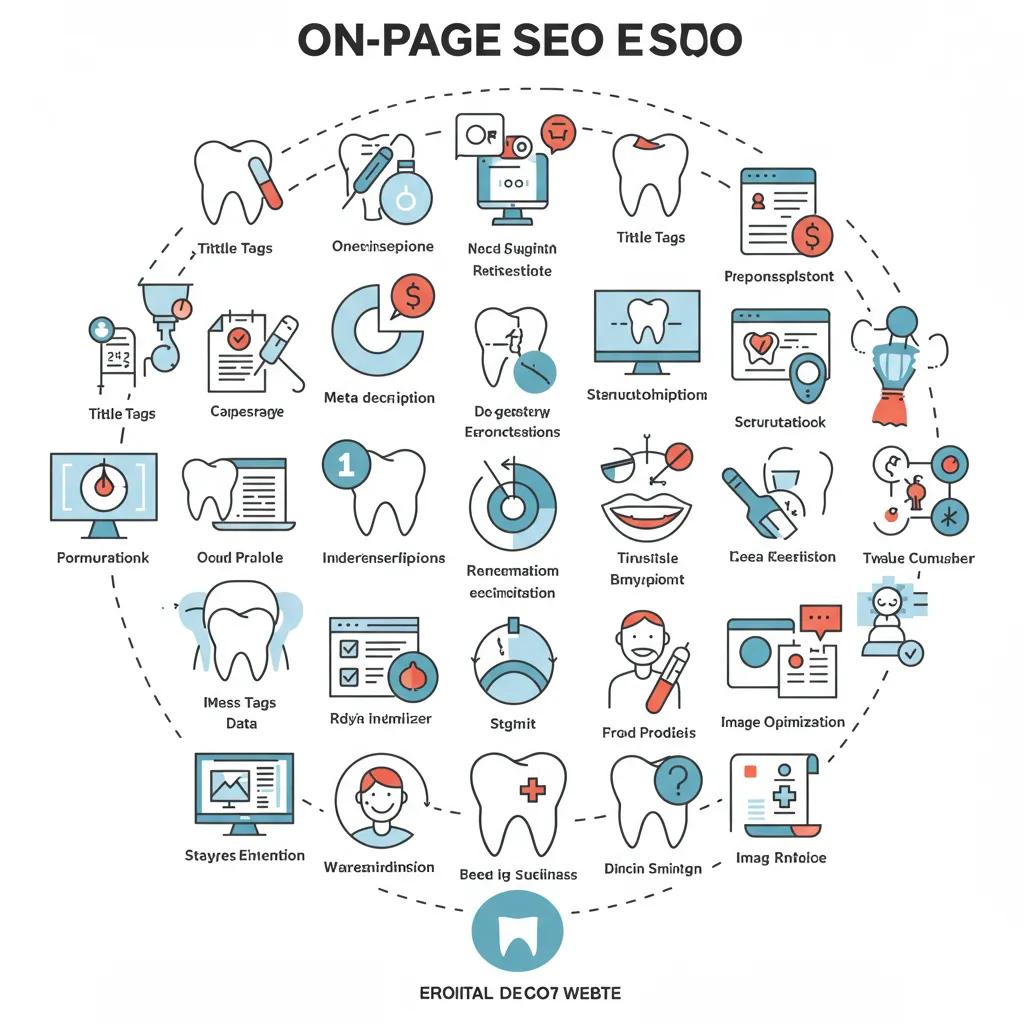
On-page elements that most affect dental rankings include title tags, meta descriptions, H1/H2 structure, body content relevance and E-E-A-T signals, structured data, image optimisation, and internal links that distribute authority. Each element signals topical relevance or affects user behaviour metrics that search engines use to rank pages. For example, a service page with a precise title tag and LocalBusiness schema communicates both intent and location to search systems, while optimised images and fast LCP improve mobile user engagement. Improving one element often amplifies others: clearer headings make content scannable, which increases dwell time and supports rankings for local queries.
How Does On-Page SEO Improve Patient Acquisition for Dentists?
On-page SEO improves patient acquisition by moving prospects through a visibility-to-conversion funnel: search visibility leads to targeted clicks, well-optimised pages convert clicks into enquiries, and trust signals close appointments. Specifically, keyword-aligned titles and meta descriptions increase qualified clicks, structured content with clear CTAs converts visitors into calls or bookings, and review signals reduce friction during decision-making. Measurable gains often follow targeted on-page work: higher local rankings produce more map clicks and calls, while faster pages reduce bounce rates and increase completed booking actions.
What Common On-Page SEO Mistakes Should Dental Practices Avoid?
Common mistakes include thin or duplicated service content, missing or incorrect structured data, slow page speed, broken mobile booking flows, and inconsistent NAP across citations. These issues harm both discoverability and user trust; for example, missing LocalBusiness schema can reduce visibility in rich results, while slow LCP hurts mobile rankings and conversions. The corrective approach is a prioritised audit: fix critical technical issues first (speed, mobile), then strengthen content and schema, and finally remediate citation consistency to ensure local relevance. Addressing these errors sets the stage for sustainable local patient acquisition through organic search.
How to Optimise Dental Website Content Strategy for SEO Success?

Content strategy for dental SEO organises pages and posts around patient intent, local relevance, and E-E-A-T signals to increase organic visibility and conversions. The strategy works by mapping high-intent local keywords to service pages, using educational blog posts to capture informational queries, and deploying FAQs and schema to claim SERP real estate. A focused content plan ensures each page has a clear purpose—inform, convert, or support—and that internal linking funnels authority to priority service pages. The following H3 sections cover keyword research, blog content, service page templates, and freshness routines that together form a repeatable editorial workflow.
What Are Effective Keyword Research Strategies for Dental SEO?
Effective keyword research maps transactional and local intent terms (service + suburb, “near me”, symptom-based queries) alongside informational long-tail questions patients ask. Start with a seed list of services, add geo modifiers, then expand with common patient questions and treatment synonyms. Prioritise keywords by local search volume and intent: convert high-intent service terms to service-page targets, and reserve informational keywords for blog posts or FAQs. This workflow builds a topical map that aligns content types to user needs and informs internal linking to strengthen page authority for local queries.
How to Craft Engaging and Authoritative Dental Blog Content?
Authoritative dental blogs educate patients, showcase expertise, and provide internal linking to service pages, which together support E-E-A-T and topical relevance. Structure posts with clear headings, evidence-based recommendations, and an author attribution that signals clinical oversight. Use patient-friendly language, include local examples when relevant, and link to clinical resources or guidelines to support claims. Regularly repurpose blogs into FAQ content and schema-enabled snippets to increase visibility and patient trust while feeding topical authority to conversion pages.
How Should Service Pages Be Optimised for Dental SEO?
Service pages should be structured to answer patient intent, demonstrate expertise, and prompt action: an H1 with primary service + location, a concise benefits section, procedural overview, trust signals (reviews summary), clear pricing or booking CTA, and LocalBusiness/Service schema. Include expected treatment outcomes, FAQ subsections addressing common concerns, and internal links to relevant blog posts. This structure improves relevance for service queries and raises conversion rates by reducing uncertainty with trust-building content and clear next steps for booking.
Why Is Content Freshness and Regular Updates Critical for Dental Websites?
Content freshness signals continued relevance and can boost rankings for time-sensitive or seasonal queries; for dental sites, updates matter for procedure improvements, new insurance info, or local service changes. Implement a review cadence: service pages every 6–12 months, blog posts every 12–18 months, and FAQ updates as patient questions evolve. Use content edits to add recent sources, update schema, and republish with visible timestamps to reflect current practice information. Regular updates maintain both search relevance and patient trust, contributing directly to consistent local traffic.
For dental practices seeking managed execution of these content strategies, Dental Marketing Services offers targeted Local SEO, Content Marketing, and Profile Management that implement service-page optimisation and editorial calendars on behalf of clinics. These services are designed to take the strategic steps above and apply them practically for practices preferring expert implementation.
| Content Type | Recommended Length | Target Intent |
|---|---|---|
| Service page | 600–1,200 words | Transactional (service + location) |
| Blog post (how-to) | 800–1,200 words | Informational / consideration |
| FAQ entry | 100–250 words | Quick answers / PAA snippets |
| Geo landing page | 400–800 words | Local discovery (suburb-level) |
What Technical On-Page SEO Factors Should Dentists Prioritise?
Technical on-page SEO ensures search engines can crawl, interpret, and deliver a dental site while users experience fast, reliable pages that convert. Technical factors include site speed optimisations, mobile-first design, accurate XML sitemaps and robots.txt, and Core Web Vitals targets that influence both ranking and user behaviour. Prioritising fixes depends on impact and implementation effort: resolve blocking crawl errors and mobile usability first, then address speed bottlenecks, and finally implement advanced improvements like resource optimisation and caching. The next H3s provide practical steps for each technical area and a compact EAV table comparing recommended thresholds.
How to Optimise Website Speed for Dental Clinics?
Website speed optimisation reduces load times and improves Core Web Vitals, directly increasing engagement and reducing bounce for appointment-focused pages. Practical quick wins are image compression and modern formats, browser caching, lazy loading non-critical assets, and minimising third-party scripts that slow rendering. Use PageSpeed Insights and Lighthouse to triage issues and prioritise changes that affect Largest Contentful Paint and Cumulative Layout Shift. For clinics with limited development resources, focus on image optimisation and caching first, then iterate to CDN deployment and script deferral for sustained improvements.
Quick site speed wins for dental sites include:
- Compress and serve images in modern formats such as WebP to reduce payload.
- Enable browser caching and a server-side cache to speed repeat visits.
- Defer or remove third-party scripts that block first render.
Web Performance Tooling and Core Web Vitals Optimisation for Business Success
In today’s digital landscape, where users demand instant and seamless web experiences, optimising web performance has become paramount for businesses to succeed online. According to a recent study[1], 52% of users will abandon a website that takes more than 3 seconds to load. This highlights the importance of measuring website speed and responsiveness using effective performance optimisation techniques. This paper delves into the significance of web performance tooling in measuring and optimising key performance indicators (KPIs) known as “web vitals.” It explores popular tools such as Lighthouse, PageSpeed Insights, and WebPageTest, analysing their functionalities and roles in enhancing web performance [2][3][4]. These tools help evaluate critical metrics like Largest Contentful Paint (LCP) and First Input Delay (FID), which directly impact user experience. Additionally, the paper investigates the importance of optimising core web vitals like LCP and FID and their impact on key metrics such as bounce rate, conversion rate, and time on site. Studies show even small delays in LCP, CLS and FID can negatively affect these business metrics[7]. Through interviews with web developers and empirical research conducted on popular websites, the paper provides insights into the practices and strategies employed to improve web vitals scores and deliver exceptional digital experiences. Overall, the research highlights how web performance tooling plays a crucial role in measuring site speed, resource optimisation, and vital KPIs. It emphasises the need for web developers to focus on optimising core vitals to enhance user experience and online business performance.
Web performance tooling and the importance of web vitals, MK Dobbala, 2022
| Metric | Recommended Threshold | Rationale |
|---|---|---|
| Largest Contentful Paint (LCP) | ≤ 2.5s | Faster perceived load increases engagement |
| Interaction to Next Paint / INP | ≤ 200ms | Ensures responsive interactions for booking flows |
| Cumulative Layout Shift (CLS) | < 0.1 | Prevents layout shifts that break CTA clicks |
Why Is Mobile-Friendliness Essential for Dental Website SEO?
Mobile-first indexing means Google evaluates the mobile version when ranking pages, so responsive design and mobile UX are critical for local dental queries often performed on phones. Mobile users expect prominent click-to-call buttons, easy booking flows, and readable content without pinch-to-zoom. Conduct mobile usability checks, ensure forms are optimised for touch, and prioritise visible CTAs above the fold for conversion. Improving mobile usability increases both search ranking potential and the conversion rate for prospective patients searching from mobile devices.
How Do XML Sitemaps and Robots.txt Files Affect Dental SEO?
XML sitemaps and robots.txt guide search engines on which pages to crawl and index, influencing discoverability for new service pages and blog posts. A sitemap should list canonical service pages, blog posts, and geo landing pages with sensible priorities and lastmod dates to encourage re-crawl. Robots.txt must not block critical assets like CSS or JS needed for rendering, and it should permit access to sitemap locations. Regularly audit crawl errors in Search Console and update sitemaps after structural changes to maintain indexation hygiene and visibility.
What Are Core Web Vitals and Their Impact on Dental SEO?
Core Web Vitals are page experience metrics—LCP, INP (formerly FID) and CLS—that quantify loading, interactivity and visual stability, directly affecting both rankings and user satisfaction. For dental websites with booking interactions, fast LCP and low INP mean users can complete appointment flows without friction, while low CLS prevents accidental CTA misclicks. Measure using Lighthouse, PageSpeed Insights and real-user monitoring, then prioritise fixes that move each metric into recommended thresholds to protect organic visibility and conversion performance.
How to Leverage Local SEO On-Page Factors for Dental Practices?
Local on-page SEO connects a dental practice to nearby patients by combining location signals, localised content and Google Business Profile management to rank for city and suburb queries. On-page tactics include optimised GBP content, NAP consistency, local schema markup and geo-targeted landing pages that reflect common patient search patterns. These elements increase visibility in local packs and maps while driving more qualified website visits and calls. The following subsections explain GBP optimisation, citation consistency, local schema, and geo-targeting templates.
How to Optimise Your Google Business Profile for Dental Clinics?
Optimising a Google Business Profile means completing categories, services, business description, photos and Q&A, and regularly posting updates and responding to reviews to maintain engagement. Include accurate service lists, well-lit interior and exterior photos, and timely responses to patient questions to improve local trust and conversion. Monitor GBP performance metrics—search vs discovery queries and direct calls—to refine content and posting cadence. Regular GBP activity also supports freshness signals that complement on-site updates and local landing pages.
Profile Management is often the easiest way for clinics to maintain consistent GBP activity and review responses. For practices preferring managed support, Dental Marketing Services includes Profile Management as part of a Local SEO approach that handles GBP optimisation and review management on behalf of clinics.
What Is NAP Consistency and Why Does It Matter for Local Dental SEO?
NAP (Name, Address, Phone) consistency across listings and citations ensures search engines and directories present a unified location signal that improves local ranking confidence. Inconsistent phone numbers, abbreviations, or address formats create ambiguity that can dilute local relevance. Audit citations regularly, prioritise corrections on primary directories and industry-specific listings, and use a canonical NAP format on the website footer and schema to reinforce the correct data. Consistent NAP reduces friction for patients and supports stronger local pack performance.
How to Implement Local Schema Markup for Dentists?
Local schema, using LocalBusiness or Dentist types, provides structured address, telephone, openingHours and map information that search engines can parse for rich results and local contexts. Place copy-paste JSON-LD in the page head or body with accurate properties such as name, address, telephone and hasMap. Include service-specific schema for common treatments to link structured service entities to corresponding pages. Proper schema increases the chance of enhanced SERP features and clarifies local intent for search systems.
| Schema Type | Attribute | Example Use |
|---|---|---|
| Dentist | openingHours | {“@type”:”Dentist”,”openingHours”:”Mo-Fr 09:00-17:00″} |
| LocalBusiness | address | Provide structured address for local pack association |
| Service | serviceType | Annotate specific treatments like “dental implants” for service linking |
What Geo-Targeting Strategies Boost Local Dental Website Visibility?
Geo-targeting strategies include creating suburb-level landing pages, using location modifiers in title tags and headings, and internal linking from central service hubs to geo pages to distribute authority. Use URL patterns that reflect location hierarchy (for example, /services/teeth-whitening-city) and create unique content on each landing page that addresses local patient needs and neighbourhood landmarks. Pair geo-targeted pages with localised schema and internal links from blogs or FAQs to strengthen relevance and capture more local search queries.
How Can Structured Data and Schema Markup Enhance Dental SEO?
Structured data clarifies page content to search systems, enabling rich results that increase visibility and click-through rates for dental practices. Implementing Dentist, MedicalBusiness, Service, FAQ and Review schema types helps search engines present appointment details, common questions, and review snippets that reduce friction for patients. Proper schema can lead to result features like knowledge panels and Q&A snippets, which enhance trust and drive higher-quality traffic. The H3s that follow provide copy-paste JSON-LD examples, explain FAQ schema benefits and outline safe use of review and HowTo schema.
How to Implement Dentist and MedicalBusiness Schema on Dental Websites?
Dentist and MedicalBusiness JSON-LD should include core properties: @type, name, address, telephone, openingHours and service offered. Insert the JSON-LD in the page head or immediately before closing body tag and validate using structured data testing tools to ensure attributes are parsed. Annotate each service page with a matching Service schema referencing the treatment name and description to link structured entities across the site. Validation and periodic checks prevent schema errors that could nullify rich result eligibility.
| Schema | Attribute | Example JSON-LD Snippet |
|---|---|---|
| Dentist | openingHours | {“@type”:”Dentist”,”openingHours”:”Mo-Fr 09:00-17:00″} |
| Service | serviceType | {“@type”:”Service”,”name”:”Dental Implants”,”description”:”Single-tooth implants”} |
| FAQ | mainEntity | {“@type”:”FAQPage”,”mainEntity”:[{…}]} |
What Are the Benefits of FAQ Schema for Dental Practices?
FAQ schema increases SERP real estate by enabling question-and-answer snippets, which can capture PAA and featured snippet placements for common patient queries. Well-structured FAQ entries reduce friction by answering booking, preparation and cost questions directly in search results, which can lower barriers to conversion. Apply FAQ schema selectively for genuine patient questions and ensure answers reflect clinical accuracy and citations where appropriate to align with E-E-A-T guidance.
How to Use Review and HowTo Schema to Build Trust and Engagement?
Review schema surfaces aggregated ratings and individual review snippets in search results, providing social proof that influences patient choices. HowTo schema is ideal for patient education pieces—such as pre-appointment preparation or post-op care—that guide patients step-by-step while enabling enhanced SERP displays. Use Review schema for verified patient feedback and ensure HowTo content is practical, safety-conscious and aligned with clinical guidance to avoid misleading instructions.
How to Improve User Experience for Better On-Page Dental SEO?
User experience improvements increase the probability that organic visitors convert into enquiries by making content accessible, trustable and action-oriented. Core UX on-page elements include internal linking for topical authority, optimised images with descriptive ALT text, concise meta titles and descriptions that boost CTR, and clear CTAs that support booking or calls. Together these elements reduce friction, reinforce expertise and make it easier for patients to act. The next subsections provide tactical internal linking patterns, image optimisation examples, metadata templates and CTA optimisation methods.
What Internal Linking Strategies Boost Dental Website SEO?
Internal linking should follow a hub-and-spoke model where hub pages (service category or main practice pages) link to detailed service pages and vice versa to pass topical authority. Use descriptive anchor text that includes service names and locations to signal entity relationships to search engines. Maintain shallow crawl depth for priority pages and audit broken links regularly. A deliberate internal linking structure helps search engines discover and rank revenue-driving pages while improving navigation for patients.
How to Optimise Images for Dental SEO with ALT Text and File Names?
Optimise images by compressing them, using modern formats like WebP, and applying descriptive file names and ALT text that include the relevant service and context. For example, an image file name such as teeth-whitening-treatment-clinic.webp and ALT text describing the procedure and location helps both accessibility and semantic relevance. Properly sized, tagged images reduce load and support LCP metrics while improving content clarity for visually impaired users and search systems alike.
How to Write Effective Meta Descriptions and Title Tags for Dentists?
Title tags should combine primary keyword and location with a unique value proposition, and meta descriptions should summarise benefit and include a clear CTA to improve CTR. For example, a title could follow the template: Primary Service — Clinic Name | Suburb, while descriptions highlight outcomes and encourage action. A/B test different meta variants to optimise CTR for priority pages and track performance in Search Console to iterate on messaging that converts.
What Call-to-Action Optimisations Increase Patient Enquiries?
High-performing CTAs are prominent, action-oriented and tailored to intent: click-to-call for mobile visitors, online booking for high-intent pages and lead forms for consult requests. Use contrasting design, concise copy and microcopy that reduces friction (e.g., “Book 15–minute consult” or “Call for emergency care”). Track CTA performance with event tracking and optimise placement based on heatmaps and conversion data. Iterative testing of CTA copy, colour and position improves conversion rates from organic traffic.
What Tools, Resources, and Case Studies Demonstrate On-Page SEO Success for Dentists?
A practical toolkit and examples make auditing and sustaining on-page SEO achievable: use PageSpeed Insights and Lighthouse for performance, Search Console for indexation and query data, and local tools for citation audits and GBP tracking. Case studies that tie specific on-page changes to measurable lifts in visibility, clicks and enquiries provide replicable templates for other practices. The following H3s list recommended tools, summarise anonymised case outcomes, present 2025 trends and show monitoring frameworks for ongoing maintenance.
Which SEO Tools Are Best for Auditing Dental Website On-Page Factors?
Choose tools that cover both technical and local audits: PageSpeed Insights and Lighthouse for Core Web Vitals; Search Console for indexing and query analysis; crawlers for broken links and sitemap validation; and local citation tools for GBP and NAP checks. Each tool serves a distinct purpose: Lighthouse for performance remediation, Search Console for content visibility issues, and local platforms for managing reviews and local listings. Combine outputs into a prioritised action list that balances effort and impact for practice resources.
How Have Dental Practices Improved Visibility Through On-Page SEO?
Anonymised case examples show common outcomes: focused service-page optimisation and local schema often increase map rankings and calls, while speed and mobile fixes raise on-site conversions. Typical interventions include rewriting title/meta for local intent, adding Service schema, compressing images to improve LCP, and creating suburb landing pages to capture local queries. These combined actions usually produce measurable uplifts in organic clicks, GBP interactions and booking form submissions for clinics that implement the changes.
For practices seeking a managed, results-driven approach, Milkcan Marketing offers Dental Marketing Services combining Local SEO, Content Marketing and Profile Management to execute on-page improvements and local optimisation on behalf of clinics. Contact options are available through Milkcan Marketing channels to enquire about service packages or request a practical checklist for on-page audits.
What Are the Latest Trends and Statistics in Dental SEO for 2025?
Recent trends emphasise mobile-first behaviour, increased importance of page experience signals, the rise of conversational queries and voice search, and growing expectations for E-E-A-T in healthcare content. Local intent searches and map-pack clicks continue to dominate patient acquisition, and schema adoption correlates with higher click-through rates for treatment-related queries. Practices should prioritise mobile UX, structured data and authoritative content to align with evolving search behaviours and algorithmic emphasis in 2024–2025.
How to Monitor and Maintain On-Page SEO Performance Over Time?
Establish a monitoring framework with KPIs such as organic impressions, clicks, GBP metrics (calls, direction requests), Core Web Vitals, and conversion events (calls, bookings). Schedule audits quarterly for technical checks, monthly for content performance reviews, and weekly for GBP activity tracking and review responses. Use automated reports from Search Console and performance tools, then prioritise action items by impact and effort to maintain steady visibility gains and patient-acquisition momentum.
- Monthly: Review Search Console queries, GBP insights and top-converting pages.
- Quarterly: Run full technical audits and content inventory for updates.
- Annually: Revisit keyword strategy and local targeting to reflect market changes.
These routines keep the site aligned with search algorithms and local patient expectations so on-page SEO improvements persist.
| Tool | Feature | Application |
|---|---|---|
| PageSpeed Insights | Core Web Vitals reporting | Prioritise speed fixes impacting LCP/CLS |
| Search Console | Query & indexing data | Monitor visibility and diagnose coverage issues |
| Local citation tools | GBP & NAP audits | Maintain citation consistency and review tracking |