
Queensland Dental SEO: Optimise Local Rankings for Brisbane Clinics
Queensland Dental SEO refers to targeted local search optimisation that helps dental clinics in Brisbane and wider Queensland appear for patient searches in their area by combining local signals, Google Business Profile strength and location-specific content to drive more appointment enquiries. This article explains how local SEO differs from general SEO, why mapping and profile optimisation matter for dentist visibility, and which tactics convert searchers into booked patients. Many Queensland clinics struggle with low visibility in map packs and fragmented citation data, so this guide promises clear, prioritised steps—from GBP configuration and technical audits to content marketing and reputation workflows—to improve local SERP placement and patient acquisition. You will learn actionable techniques for keyword targeting, a checklist for Google Business Profile optimisation, content formats that attract local patients, reputation management tactics, and technical audit priorities that directly influence rankings. Throughout we reference practical tools and the types of agency support available for clinics that prefer to outsource implementation, while keeping the focus on hands-on steps you can take immediately to raise local clinic visibility.
How Can Local SEO Strategies Improve Your Queensland Dental Clinic’s Online Visibility?
Local SEO improves visibility by aligning clinic assets—Google Business Profile, localised website pages and consistent citations—with the search behaviour of Queensland patients, ensuring clinics appear in the map pack and local search results for queries with high booking intent. This works because search engines evaluate local relevance through proximity signals, profile completeness, review signals and on-page localisation to determine which clinics best match a patient’s needs near them. The result is increased qualified traffic, more map-driven actions like calls and directions, and improved conversion rates when on-site booking flows are optimised. Clinics that prioritise local keyword mapping, GBP health and targeted landing pages typically see better maps placement and higher local click-through rates than those relying on generic, non-local SEO.
Local SEO delivers practical benefits for dental practices in three core areas:
- Increased local patient visibility: patients searching for nearby dentists find your practice in maps and search results.
- Stronger conversion signals: GBP actions (calls, bookings, directions) directly lead to measurable appointments.
- Targeted traffic: localised pages match patient intent and improve booking likelihood.
These outcomes follow directly from optimising local ranking signals, which leads us into the specific techniques Brisbane dentists should prioritise for rapid gains.
H3: What Are the Key Local SEO Techniques for Brisbane Dentists?

Key local SEO techniques for Brisbane dentists centre on targeted keyword research, on-page localisation, citation consistency and schema markup to tell search engines where and what you serve. Start by mapping local intent keywords—phrases such as “Brisbane dentist emergency”, “cosmetic dentist near South Brisbane” or “children’s dental clinic Brisbane”—and use them to structure service and suburb landing pages that match patient queries. Ensure NAP (name, address, phone) is consistent across all directories and citations, and implement LocalBusiness and Service schema to provide structured context about services and locations. Prioritise tasks in this order: GBP and citations, targeted landing pages, on-page schema, and then local backlink acquisition; this sequence creates quick local relevance and then builds authority.
These tactics form the conversion pathway described next, so understanding how visibility becomes bookings is the next step.
H3: How Does Local SEO Drive Patient Acquisition for Dental Practices?
Local SEO drives patient acquisition by converting search intent into actions: a patient searches locally, sees your GBP and site, and completes a micro-conversion such as click-to-call, directions or an online booking. Optimise your GBP with clear service listings and booking links, use local landing pages with strong calls to action, and add click-to-call buttons and simple booking forms to reduce friction for mobile users. Tracking via GBP insights, call tracking and form analytics ties visibility to real-world outcomes so clinics can prioritise the highest-performing channels. Measuring these action metrics enables clinics to iterate on content and profile signals to increase both volume and quality of patient leads.
These conversion mechanics highlight why Google Business Profile optimisation is central to Queensland dental SEO, which we cover next.
What Are the Best Practices for Google My Business Optimisation for Dental Clinics?
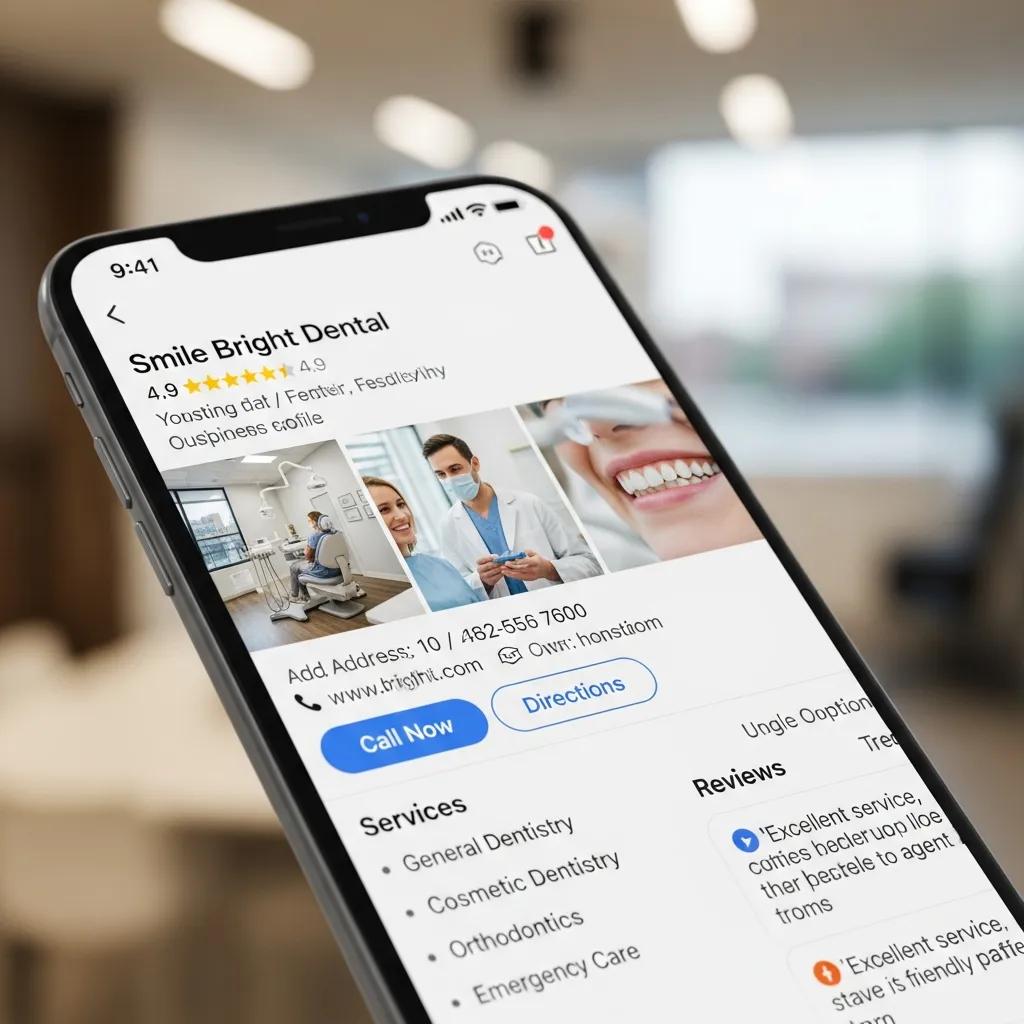
A fully optimised Google Business Profile (GBP) is a primary local ranking signal and conversion driver for dental clinics, combining structured business data with user-generated signals like reviews and photos to influence map-pack placement. Start by claiming and verifying your GBP, selecting precise primary and secondary categories (e.g., “Dentist” and relevant specialty categories), and completing all profile fields including services, booking links and accurate opening hours. Regularly publish GBP posts with local content, upload high-quality photos of the clinic and staff, and use service descriptions that contain local keywords and clear CTAs. Review management—soliciting and responding to patient feedback—maintains recency and relevance, which strengthens GBP performance over time.
Below is a comparative table showing critical GBP attributes and how each influences local SERP outcomes to help clinics prioritise optimisation tasks.
This table shows which profile elements to prioritise first: completeness and categories, followed by reviews and media. After implementing these GBP best practices, clinics should apply on-site schema and tracking to capture GBP-driven traffic, which we address in the next subsection.
H3: How to Set Up and Enhance Your Dental Clinic’s Google My Business Profile?
Setting up and enhancing a dental clinic’s GBP begins with claiming the listing and completing every profile section to provide search engines with clear structured data and prospective patients with easy booking paths. Write a concise but localised business description that includes clinic services and suburb names, add direct booking or phone links for immediate conversions, and create service entries that mirror your site’s service pages for semantic consistency. Add a suite of high-resolution photos—treatment rooms, staff, and community events—to build trust and engagement, and schedule regular GBP posts about promotions, seasonal advice and clinic updates to demonstrate activity. Finally, implement review request workflows at point-of-care and in follow-up communications to generate steady, recent feedback that supports ranking and conversion.
Completing these steps supports why GBP is critical to local SEO, which is explained next.
H3: Why Is Google My Business Critical for Queensland Dental SEO?
Google Business Profile is critical because it directly affects map-pack visibility, provides measurable patient actions such as calls and direction requests, and supplies local relevance signals through categories and reviews that search engines use to rank businesses. For Queensland clinics, strong GBP signals often determine whether a practice appears for nearby patients on both desktop and mobile, where map-pack prominence drives the majority of local clicks. GBP also serves as the first impression for many patients—rich media, accurate service lists and recent positive reviews increase the likelihood of contact. Therefore, a healthy GBP combined with localised website content forms the backbone of an effective Queensland dental SEO strategy.
To translate visibility into patient interest, content marketing tailored to local needs is the next essential pillar we will explore.
Which Content Marketing Tactics Effectively Attract Dental Patients in Queensland?
Content marketing for Queensland dental clinics focuses on creating localised, intent-driven pages and resources that answer patient questions and demonstrate expertise, which in turn builds trust and improves organic discovery for local queries. The most effective content tactics combine high-intent service pages with educational blog posts, FAQs and multimedia that reflect local contexts such as suburb names, local events or community health needs. Content distribution via GBP posts and local social channels amplifies reach while video testimonials and procedure explainers boost credibility and conversion rates. Prioritise service and location pages for immediate booking intent, then develop educational long-tail content to capture early-stage searchers and build topical authority.
Top content types that attract patients are listed below with brief benefits to aim for featured snippets and improved conversion.
The following types of content are particularly effective for healthcare SEO in a local context:
- Service & Location Pages: Directly match high-intent local queries and drive bookings.
- Patient Education Blogs: Capture long-tail queries and establish clinical authority.
- FAQs & Procedure Guides: Answer common patient concerns and reduce barriers to booking.
- Video Testimonials & Procedure Explainers: Build trust and improve on-site engagement.
- Local Community Content: Strengthen local relevance and earn local backlinks.
These content types should map to the patient funnel—awareness, consideration and conversion—which we explain in the next subsection.
Below is a comparison table that shows how content types differ by reach, trust-building and conversion intent to help you prioritise content production.
Use this matrix to allocate content resources: start with service pages and FAQs, then expand to blogs and multimedia to build authority and referral traffic that supports long-term SEO.
H3: How Can Targeted Content Marketing Boost Dental Practice Patient Engagement?
Targeted content marketing boosts engagement by aligning content topics to specific patient intents—informational queries get educational blogs; transactional queries get optimised service pages—thereby improving time on page, reducing bounce and increasing appointment requests. Use localised topics and neighbourhood terms to attract nearby patients, incorporate structured data and CTAs on pages to facilitate booking, and repurpose high-performing blog content into GBP posts or short videos for wider distribution. Track metrics such as organic sessions to service pages, lead form submissions and GBP-driven calls to measure engagement improvements and refine topics. Consistent, targeted content builds trust and makes the clinic the obvious choice when patients are ready to book.
This engagement focus leads into which content formats to prioritise, which we cover next.
H3: What Types of Content Work Best for Healthcare SEO in Queensland?
For healthcare SEO in Queensland, prioritise service & location pages for immediate patient intent, educational blogs for long-tail discovery, FAQs for conversion and video testimonials for trust—each format addresses a specific point in the patient journey. Service pages should include clear treatment descriptions, pricing transparency elements where suitable, and local signals like suburb names and schema markup for services. Educational blogs capture discovery queries and can be used to answer seasonal concerns or local health topics, while FAQs reduce friction by providing concise, authoritative answers to appointment-related questions. Video and before/after galleries provide social proof and improve time on page for conversion-focused content.
A balanced content plan mixes these types to maintain both short-term bookings and long-term organic growth, which ties into reputation management covered next.
How Does Online Reputation Management Impact Queensland Dental SEO Success?
Online reputation management intersects with SEO because review volume, sentiment and response behaviour contribute to local relevance and influence click-through rates from search results; a positive reputation also increases the probability of conversions from GBP and site visits. Reviews act as social proof and can affect ranking indirectly through higher engagement signals and direct GBP relevance. Establishing workflows to solicit, monitor and respond to reviews ensures review recency and diversity, while surfacing testimonials on-site improves perceived credibility and CTR. Monitoring key reputation KPIs—review volume, average rating, response time and sentiment trends—helps clinics prioritise interventions and demonstrates the ROI of reputation work on lead generation.
Below is a practical list of reputation tactics dental clinics can implement to build and protect their online reputation.
- Ask for reviews at point-of-care and in post-appointment follow-ups to generate steady, recent feedback.
- Respond promptly and professionally to all reviews to show engagement and patient care.
- Feature review snippets and testimonials on service pages and location landing pages to boost trust.
These tactics feed into how to acquire and manage reviews, which we outline in the next subsection.
H3: What Are Effective Strategies for Managing Dental Clinic Reviews?
Effective review management begins with a simple, ethical request strategy: ask satisfied patients at point-of-care, follow up with a polite reminder, and make leaving feedback easy by linking to your GBP or feedback channels. Create response templates for common review types—thank-you replies for positive reviews and empathetic, solution-oriented responses for negative feedback—to maintain consistency and professionalism. Monitor reviews regularly to identify patterns in service issues or praise, and surface positive testimonials on your website and GBP to improve conversions. Finally, use review metrics alongside booking and call tracking to quantify reputation impact on patient acquisition.
Handling reviews properly supports local rankings and patient trust; next we look at how positive feedback influences search performance.
H3: How Can Positive Patient Feedback Enhance Local Search Rankings?
Positive patient feedback enhances rankings by increasing GBP engagement metrics and signalling relevance and trust to search engines, which often prioritise businesses with higher review counts and better ratings for local queries. Volume, recency and diversity of reviews are important signals: frequent, recent reviews demonstrate an active, trusted practice that serves patients regularly. Positive reviews also improve click-through rates from search results because prospective patients see higher ratings and reassuring testimonials, which increases the likelihood of site visits and calls—behavioural signals that further support ranking. Surface reviews on local landing pages with schema markup to maximise their SEO value and improve conversion rates from organic traffic.
With reputation and content aligned, technical SEO and audits ensure the website can capture and convert the traffic you earn, which is covered next.
What Are the Essential SEO Audit and Technical SEO Steps for Dental Websites?
A comprehensive SEO audit for dental websites focuses on on-page localisation, technical performance (speed and mobile UX), structured data implementation and local citation health to ensure maximum discoverability and conversion for Queensland patients. Begin with GBP and citation checks to ensure consistency, then evaluate mobile responsiveness and Core Web Vitals to reduce friction for the majority of local searches occurring on mobile devices. Verify LocalBusiness and Service schema on key pages, ensure site architecture supports clear service and location landing pages, and audit internal linking to promote topical authority. Prioritise quick wins—GBP and citations, meta and heading optimisation—before addressing medium-term tasks like content expansion and backlink acquisition.
The following EAV table compares technical elements, their attributes and priority levels to guide an audit roadmap specific to dental clinics.
Use this table to sequence technical fixes: speed and mobile first, then schema and crawlability, then iterative improvements to content and backlinks.
H3: How to Conduct a Comprehensive SEO Audit for Queensland Dental Clinics?
Start an audit by reviewing Google Business Profile health and local citations, ensuring consistency across directories, then run on-site checks for meta titles, H1s and page content localisation to match target keywords. Use speed and mobile testing tools to identify Core Web Vitals issues and prioritise fixes like image optimisation, caching and simplified page layouts for appointment flows. Verify structured data on service and location pages and confirm proper indexing by checking sitemaps and crawl reports. Finally, prioritise fixes as quick wins (GBP, citations, meta), medium-term (speed, schema), and long-term (content and backlinks) so clinics with limited resources can focus on highest-impact tasks first.
This ordered approach reveals which technical factors matter most and how to prioritise remediation, discussed next.
H3: Which Technical SEO Factors Influence Dental Practice Online Visibility?
Core technical factors that influence visibility include mobile-first design and Core Web Vitals, structured data for LocalBusiness and Services, crawlability and a logical site structure that surfaces service and location pages. Mobile-first design ensures patients on smartphones can book or call without friction, while Core Web Vitals metrics like LCP and CLS directly affect ranking and user experience. Structured data helps search engines understand services and can trigger rich results that increase CTR, and clear site architecture with internal links ensures authority flows to high-intent pages. Addressing these technical factors produces measurable improvements in both rankings and patient conversion rates.
After technical fixes and content work, some clinics choose specialised agency support to accelerate results; the next section outlines how Milkcan Marketing approaches Queensland dental SEO.
How Can Milkcan Marketing Services Help Queensland Dentists Improve Local SEO?
Milkcan Marketing is a digital marketing agency in Australia that specialises in SEO and online marketing for healthcare providers, including dental clinics in Queensland, offering targeted local SEO, GBP optimisation, content marketing and reputation management structured to increase clinic visibility and patient leads. Their approach, as described in available service summaries, emphasises healthcare-specific expertise, personalised SEO campaigns for small practices and a results-driven lead generation focus designed to improve appointment acquisition. Clinics considering external support can expect an audit-driven plan that prioritises GBP health, local landing pages and review workflows with measurable KPIs. If a clinic prefers to outsource implementation, Milkcan Marketing provides the types of local SEO services that align directly with the tactics recommended in this guide.
Below is a concise service overview table to clarify the core offerings relevant to Queensland dental clinics without overstating outcomes.
These services reflect the practical support clinics often need to implement the strategies in this article; next we describe how campaigns are personalised at a high level.
H3: What Unique Healthcare SEO Solutions Does Milkcan Marketing Offer?
Milkcan Marketing’s reported unique approaches include a healthcare focus that recognises clinical compliance and patient sensitivities, personalised campaigns tailored to small practices, and a lead-generation orientation that aligns SEO activities with measurable appointment metrics. This specialisation allows for content and messaging that respect healthcare best practices while optimising for local intent queries common among Queensland patients. Personalisation involves tailoring service pages and GBP messaging to local communities and patient demographics so that content resonates and converts. These attributes make agency support practical for clinics seeking to accelerate local visibility without diverting clinical resources.
Understanding personalisation helps clinics evaluate how external support will fit into their workflows, described next.
H3: How Does Milkcan Marketing Personalise SEO Campaigns for Dental Clinics?
Personalisation typically follows an audit → strategy → implementation → monitoring cycle: an initial audit assesses GBP, citations, site structure and content gaps; strategy sets priorities for local landing pages and reputation workflows; implementation executes technical fixes and content creation; and monitoring measures GBP insights, traffic and lead metrics to iterate. For small healthcare practices, this approach emphasises manageable, high-impact tasks—like citation cleanups and targeted service pages—over large-scale campaigns to deliver measurable leads. Reporting focuses on patient acquisition metrics so clinics can see the direct relationship between SEO activities and appointment growth.
After reading about agency support, clinics should consider their next practical steps to implement these recommendations and/or inquire about tailored help with an expert partner.
Milkcan Marketing offers audit-driven, healthcare-focused local SEO services that can be engaged for clinics seeking external implementation and monitoring support; clinics interested in tailored assistance are invited to contact the agency to discuss needs and next steps.