Practical Patient Communication Strategies for Healthcare Practices
Personalised communication in healthcare means matching the message, channel and timing to each patient’s needs, preferences and health literacy so information is clear and actionable. This article explains what tailored communication looks like in practice, how it works, and why aligning messages to patient personas improves understanding, trust and treatment adherence. Small clinics can deliver patient‑centred communication using content, local search presence and straightforward technology — without large budgets or technical overhead. Below you’ll find why personalised communication matters, the core strategies to tailor messages, simple implementation steps for small teams, ways to measure success, Australian considerations and emerging tools that make personalisation practical. We use terms like individualised care, patient‑centred communication and health literacy to show how Content Marketing, Local SEO and Reputation Management link to better clinical outcomes. Read on for step‑by‑step tactics, handy comparisons and checklists you can start using this month to improve patient experience and retention.
Why is personalised patient communication crucial for healthcare practices?
Personalised patient communication is the intentional shaping of messages and channels so clinical instructions, appointment reminders and educational material suit each patient’s needs and understanding. It reduces misunderstandings, shows empathy and makes next steps clear — all of which boost adherence and satisfaction. Practices that get this right usually have better retention and stronger word‑of‑mouth, because patients who feel understood are more likely to follow care plans and recommend the clinic. Clear, relevant communication also cuts no‑shows and administrative friction by delivering the right prompt at the right time.
We’ll look next at the specific mechanisms and measurable benefits that explain how personalised messages build trust and improve outcomes.
How does tailored communication build patient trust and satisfaction?
Tailored communication builds trust by being relevant and easy to act on: messages that reference a patient’s condition, cultural background or preferred channel feel personal rather than generic. When clinicians and staff use plain language, check understanding and follow up with useful resources, patients report higher satisfaction and are likelier to stick with their care plan. For example, a short post‑procedure SMS that lists key recovery steps and invites questions reduces anxiety and encourages timely contact if something’s wrong. These elements — empathy, clear content and timely follow‑up — create better experiences that routinely lead to stronger reviews and patient referrals, which we explore next.
What impact does individualised communication have on patient retention and acquisition?
Individualised communication supports retention by keeping ongoing, relevant touchpoints that reinforce care plans and remind patients about follow‑ups or preventive care, which lowers attrition over time. It also helps acquisition: targeted local messaging and helpful educational content attract prospective patients searching for condition‑specific information and nearby practices that understand their needs. Typical, measurable results include higher appointment conversion from local search, more repeat visits and an increase in positive reviews that feed further acquisition. Knowing these retention and acquisition channels helps you prioritise which patient journeys to personalise first — a topic covered in the next section.
What are the key patient communication strategies for tailoring messages?
Personalisation needs a simple, repeatable strategy: build patient personas, segment by behaviour or condition, match channels to preferences and create content that suits each stage of the patient journey. These core steps form a measurable framework that improves clinical outcomes and supports practice growth. Below are practical strategies and how they work for small clinics.
Personalised outreach relies on a handful of repeatable strategies:
- Develop patient personas: Create compact profiles (age, concerns, tech habits) that guide tone and message content.
- Segment by behaviour and condition: Use appointment history and diagnosis groups to target reminders and education.
- Match channel to preference: Pick email, SMS, phone or GBP messaging based on urgency and the patient’s tech comfort.
- Create stage‑specific content: Produce articles, FAQs and follow‑up templates mapped to pre‑visit, during care and post‑visit stages.
These steps form the backbone of a tailored communication programme and lead into practical persona templates and channel comparisons.
How can patient personas guide targeted and relevant messaging?
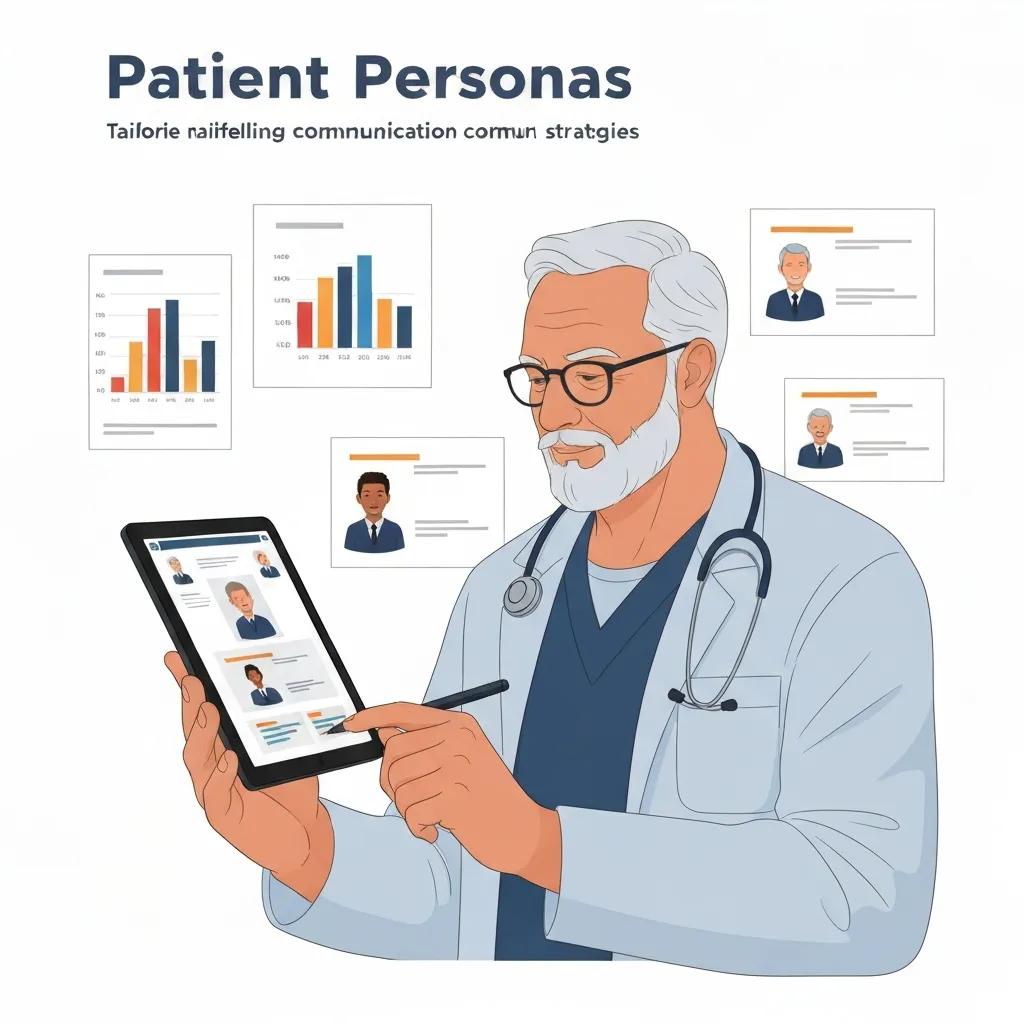
Patient personas are short archetypes that capture the communication details that matter: age, health literacy, main concern, access limitations and preferred contact method. You only need basic data from booking forms, a couple of intake questions and observations of common concerns to create three or four reusable templates for your clinic. With personas in place, staff can choose language, frequency and resource types that suit each profile — for example, a parent persona gets a concise appointment reminder and a short FAQ, while an older patient persona might receive a phone confirmation and a printed aftercare summary. Personas turn ad‑hoc messaging into consistent, measurable outreach you can scale with minimal overhead.
Which digital channels best support individualised patient outreach?
Channel choice depends on urgency, privacy and patient preference. Common options are email for detailed education, SMS for time‑sensitive reminders, phone for complex or sensitive conversations, patient portals for secure messages, and Google Business Profile messaging for quick local enquiries. Each channel has different customisation and compliance trade‑offs, so match channel to persona and message type rather than using one approach for everything. The table below helps guide that selection.
This table compares common digital channels by best use, personalisation potential and typical response to help small practices choose the right mix for each persona and message type.
| Channel | Best Use Case | Personalisation Level | Typical Response Expectation |
|---|---|---|---|
| SMS | Appointment reminders, urgent follow‑ups | High (short, targeted) | Very high open rate; fast responses |
| Detailed education, care plans, newsletters | Medium (longer content) | Moderate open/click rates | |
| Phone | Complex discussions, consent, sensitive topics | Very high (real‑time) | Strong personal connection; scheduled calls |
| Patient Portal | Test results, secure messages | High (secure delivery) | Moderate; depends on platform uptake |
| Google Business Profile Messaging | Local queries, first contact | Low–medium (concise) | Quick local enquiries; useful for acquisition |
Combining channels — SMS for reminders and email for education, for example — gives the right balance of reach and depth to support adherence and informed consent.
How can small healthcare practices implement personalised communication effectively?
Small practices should take a pragmatic, phased approach: pick priority workflows (appointments, reminders, post‑visit follow‑ups), make templates tied to personas and introduce one technology at a time to automate routine touches. Start with high‑impact, low‑effort changes such as tailored SMS reminders and persona‑based FAQs to see quick wins in no‑shows and patient satisfaction. Train staff with concise scripts, canned replies and clear escalation rules so messages stay consistent across the team. Technology should enable staff, not overwhelm them — choose lightweight CRM or messaging tools that integrate with your booking system and support basic segmentation.
To help decision‑making, the table below compares low‑cost technologies by cost, ease of integration and primary function so you can pick tools that deliver the biggest impact quickly.
| Tool Type | Cost Consideration | Ease of Integration | Recommended Use‑Case |
|---|---|---|---|
| SMS gateway | Low monthly fees | Easy (API or plugin) | Appointment reminders and urgent alerts |
| Lightweight CRM | Moderate setup | Moderate | Basic segmentation and message history |
| Email platform | Low (tiered pricing) | Easy | Educational sequences and newsletters |
| Patient portal add‑on | Variable | Moderate | Secure test results and messages |
| GBP messaging | Free | Very easy | Local enquiries and quick booking questions |
That overview clarifies which low‑cost tools give the biggest returns for small teams so you can prioritise adoption and keep integration simple.
Use the checklist below to turn strategy into action over the next 60 days — clear, staff‑friendly steps that scale personalisation without extra headcount.
- Fill out a simple persona sheet for three common patient types.
- Set up SMS appointment reminders with personal tokens (patient name, appointment time).
- Create three short post‑visit templates: discharge summary, FAQs and a follow‑up prompt.
- Run a basic email drip for new patient onboarding or procedure prep.
- Assign a team member to monitor GBP messages and review requests weekly.
These steps help small clinics establish a predictable cadence of personalised touches that reduce admin load and improve patient experience. By sequencing changes — from SMS reminders to email education — you can measure impact incrementally and broaden processes as the team gains confidence. These workflows make personalisation scalable while keeping quality and compliance consistent.
If you’d rather bring in external help, Milkcan Marketing offers practical support to operationalise these steps — Content Marketing to create patient‑focused blogs and FAQs, Profile Management to tidy local listings and messaging, and Local SEO to make your content visible to nearby patients. Our Australia‑based focus means we deliver ready‑to‑use content and simple profile fixes so busy clinic teams can implement personalised communication without diverting clinical resources. Working with a specialist partner speeds results while keeping you in control.
What role does content marketing play in delivering tailored health information?
Content marketing provides the patient‑facing assets — blog posts, FAQs, videos and email templates — that answer specific questions and match patient personas and care stages. Good content improves health literacy by using plain language, visuals and clear next steps so patients can act on advice, reducing avoidable calls and confusion. For example, a short procedure prep article for dental patients can cut pre‑appointment uncertainty and lower cancellations. At Milkcan Marketing we focus on creating patient‑centred assets — blog posts, FAQ pages and email templates — that clinics can reuse and adapt to different personas and local search needs.
How does profile and reputation management enhance patient engagement?
An optimised Google Business Profile and a proactive review strategy make personalised messages more discoverable and credible when local patients search. Keeping your profile current, enabling messaging and replying to reviews with empathy and useful information all reinforce the quality of communication patients receive during and after care. Asking for reviews using short, respectful templates boosts volume and recency, which improves visibility and provides social proof that helps acquisition. Use review themes to refine your messaging — responding to common feedback closes the loop and lifts future communication quality. Learn more about online reputation and patient trust-building strategies to enhance your practice’s engagement.
How do you measure the success of tailored patient communication?
Measure success with KPIs that map to engagement, satisfaction and conversion: open and click rates for digital outreach, appointment conversion and no‑show rates for operational impact, and NPS or review sentiment for satisfaction. Each KPI tracks a different outcome — engagement, action or sentiment — and monitoring them over time shows whether personalised messages change patient behaviour and perception. Use simple tools: CRM reports for conversions, email/SMS analytics for opens and clicks, and short periodic surveys for satisfaction. Regular reporting and iteration turn personalisation from a set of tactics into a continuous improvement cycle.
The table below maps key metrics to what they measure and suggested targets to help practices set realistic benchmarks.
| Metric | What It Measures | Suggested Target / Example |
|---|---|---|
| Open rate (email) | Initial engagement with educational content | 40–60% depending on list quality |
| Click rate (email) | Interest leading to actions or resources | 5–15% |
| SMS response or click | Immediate patient action or confirmation | 15–30% |
| Appointment conversion | Bookings from outreach or local search | Increase by 5–10% after optimisation |
| No‑show rate | Operational efficiency and reminder effectiveness | Reduce by ~20% with reminders |
| NPS / review sentiment | Patient satisfaction and advocacy | Aim for NPS > 30 and steady positive reviews |
Tracking these KPIs delivers actionable signals: low open rates point to content or segmentation issues, while rising appointment conversions show personalised outreach is driving behaviour. Regularly review metrics and link them to specific campaigns or persona segments so you can tweak tone, timing and channel mix to improve outcomes.
Milkcan Marketing can help busy practices with KPI tracking and reporting, combining Local SEO and Reputation Management data with outreach metrics to present a clear performance picture. We offer periodic audits and reports that highlight quick wins and areas to improve, plus a soft call‑to‑action for practices that want an external review of their communication performance.
Which metrics best reflect patient engagement and satisfaction?
Engagement metrics — open and click rates, SMS read/response rates and portal logins — show whether patients notice and interact with messages. Conversion metrics — appointment bookings and follow‑through — show whether messages drive action. Satisfaction metrics like NPS, short post‑visit surveys and review sentiment indicate perceived quality and trust. Benchmarks vary by channel and practice size, but small improvements in open/click rates usually mean better targeting; drops in no‑show rates and more positive reviews tie directly to revenue and reputation. Tracking both engagement and satisfaction gives a fuller view of communication effectiveness and where to focus next.
How can reputation management influence online presence and patient trust?
Reputation management improves visibility and trust by increasing review volume, lifting sentiment and making sure profile information is accurate across local listings — signals search engines use to rank local practices. Practical tactics include asking satisfied patients for reviews with short scripts, responding to feedback with empathy and corrective actions, and adding FAQs that tackle recurring concerns from reviews. These steps not only boost search visibility but also make initial outreach and personalised messages more persuasive because prospective patients find supporting social proof. Better online trust increases the effectiveness of tailored acquisition messages and helps conversion from local search.
How is personalised communication adapted to the Australian healthcare context?
Australian patients often expect transparent pricing, clear service descriptions and mobile‑friendly interactions, so personalised communication should reflect those priorities. Offer cost estimates where appropriate, use plain language for consent and follow‑up, and make content mobile‑optimised given high smartphone use. Local regulations focus on privacy and consent for messaging, so adopt opt‑in approaches and store patient communication preferences securely. Tailoring messages to Australian norms — pragmatic, transparent and mobile‑first — improves satisfaction and local search performance.
Those local expectations lead to practical steps and local SEO tactics we expand on below.
What are the unique patient expectations and communication preferences in Australia?
Patients here typically value clear information about likely costs, straightforward instructions on next steps and the convenience of mobile‑first interactions like SMS and mobile booking. There’s an expectation of a respectful, direct tone and access to Medicare or cost guidance where relevant. Use clear headings, short action points and accessible language to respect diverse health literacy levels. Matching tone and content to these preferences reduces friction and increases perceived professionalism, supporting retention and local reputation.
How do local SEO and digital marketing support tailored communication in Australian practices?
Local SEO and targeted content help persona‑aligned information appear for nearby patients when they search — using local keywords, Google Business Profile optimisation and location pages to answer community questions. Localised FAQs and procedure pages that reference suburb names or common local queries match search intent and feed personalised outreach once someone engages. Quick wins include completing your GBP, soliciting local reviews and publishing short localised posts that answer frequently searched questions. These assets both capture demand and give personalised messages context that increases relevance and trust.
What are the emerging trends and technologies enhancing individualised healthcare communication?
Key trends for small practices include telehealth workflows, AI‑assisted message personalisation and lightweight CRMs that automate basic segmentation. Telehealth supports continuity and timely follow‑up across geography, while AI tools can surface which content works for specific personas and suggest subject lines or message variants to lift open rates. Affordable automation reduces manual work and helps small teams keep personalised outreach consistent at scale. Choose technologies that prioritise privacy, simplicity and integration so workflows stay manageable and sustainable.
These technologies connect directly to telehealth and practical tool choices clinics can adopt; we examine those next.
How does telehealth facilitate personalised patient interaction?
Telehealth creates chances for personalised assessments, convenience and quick clarification that strengthen continuity of care. Clinicians can tailor follow‑up schedules and send targeted resources after virtual appointments. Operationally, map telehealth visits to personas and follow‑up sequences, with automated reminders and short post‑visit messages referencing the consultation. Best practice is to confirm technical access before the appointment, send a brief summary afterwards and schedule short check‑ins where needed — these steps keep personalisation manageable without adding workload. Telehealth becomes another channel that integrates with your broader outreach to create a consistent, personalised patient journey.
Which accessible technologies help small practices deliver tailored communication?
Affordable tools that support personalisation include simple CRMs for segmentation, SMS platforms for timely reminders, basic email automation for educational sequences and patient portal add‑ons for secure delivery. Each has trade‑offs between cost and features — favour tools with minimal setup, template messaging and exportable reports so clinics can track impact without heavy technical support. Start where the pain is greatest (often SMS reminders) and scale to email sequences and portal messages as capacity allows. Prioritising accessible tech ensures personalisation improves outcomes without creating unsustainable complexity for small teams.
If you want help turning these tactics into a working programme, Milkcan Marketing specialises in supporting small Australian healthcare practices with Local SEO, Content Marketing and Profile Management to make personalised communication practical. We deliver actionable assets and profile fixes that lift discoverability and patient trust, and we can run a performance audit to identify quick wins and measurable improvements.
Frequently asked questions
What are the benefits of using telehealth for personalised patient communication?
Telehealth makes consultations more convenient and lets clinicians tailor follow‑up schedules and resources to the patient’s needs. It also enables immediate clarification of concerns, so patients feel supported during their care journey. When combined with other outreach channels, telehealth helps practices maintain a consistent, personalised experience that improves satisfaction and adherence to treatment plans.
How can small practices ensure compliance with privacy regulations when personalising communication?
Use opt‑in consent for messaging, store patient preferences securely and send sensitive information only via encrypted or secure channels. Regular staff training on privacy policies and communication best practice is essential. Review your communication approach periodically to make sure it aligns with local regulations and protects patient data while still delivering personalised care.
What role does health literacy play in personalised patient communication?
Health literacy determines how well patients understand health information and instructions. Tailoring communication to a patient’s literacy level — using plain language, visuals and short summaries — makes messages clearer and more actionable. Considering health literacy reduces misunderstandings, improves engagement and increases adherence to care plans, leading to better outcomes.
How can practices measure the effectiveness of their personalised communication strategies?
Track KPIs such as open and click rates, appointment conversion and patient satisfaction scores. Analyse these metrics regularly to spot trends and areas for improvement, and run short surveys for qualitative feedback. Linking results to specific campaigns or persona segments helps you refine tone, timing and channel choices to improve the patient experience.
What are some common challenges small practices face when implementing personalised communication?
Common challenges include limited resources, lack of suitable technology and inconsistent staff training. Budget constraints can slow tool adoption and teams may struggle to maintain consistent messaging without clear processes. Start with simple, cost‑effective solutions and scale gradually, making sure staff have clear scripts and training to keep messaging consistent.
How can local SEO enhance personalised communication for healthcare practices?
Local SEO helps your persona‑aligned content surface when nearby patients search. By optimising Google Business Profile details, using local keywords and publishing location‑specific pages, you attract patients looking for tailored care. Localised FAQs and short educational posts make your outreach more relevant and give personalised messages credible, searchable assets to reference.
Conclusion
Personalised patient communication improves engagement, satisfaction and clinical outcomes. By adopting simple persona‑driven strategies, matching channels to preferences and using lightweight technology, small practices can build trust and boost retention without heavy investment. If you’re ready to start, use the checklists and tactics here and consider the support options available to accelerate results. Make personalised communication part of your practice — it’s a practical way to elevate patient experience and long‑term loyalty.